

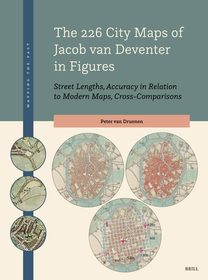
The 226 City Maps of Jacob van Deventer in Figures
Street Lengths, Accuracy in Relation to Modern Maps, Cross-Comparisons
Series: Mapping the Past; 8;
- Publisher's listprice EUR 215.00
-
83 979 Ft (79 980 Ft + 5% VAT)
The price is estimated because at the time of ordering we do not know what conversion rates will apply to HUF / product currency when the book arrives. In case HUF is weaker, the price increases slightly, in case HUF is stronger, the price goes lower slightly.
- Discount 5% (cc. 4 199 Ft off)
- Discounted price 79 780 Ft (75 981 Ft + 5% VAT)
Subcribe now and take benefit of a favourable price.
Subscribe
83 979 Ft

Availability
printed on demand
Why don't you give exact delivery time?
Delivery time is estimated on our previous experiences. We give estimations only, because we order from outside Hungary, and the delivery time mainly depends on how quickly the publisher supplies the book. Faster or slower deliveries both happen, but we do our best to supply as quickly as possible.
Product details:
- Edition number 1
- Publisher Brill
- Date of Publication 18 June 2026
- ISBN 9789004755024
- Binding Paperback
- No. of pages576 pages
- Size 28 mm
- Weight 1925 g
- Language English 688
Categories
Long description:
In this publication, Peter van Druenen presents an innovative method by which – for the first time – all 226 city maps created by Jacob van Deventer between 1545 and 1575 have been systematically and consistently measured, analysed for quality, and compared. The essence of this ‘Passus Method’ lies in considering the relationship between the length of built-up street sides and the size of a city’s population. The method enables objective comparisons with other city maps from the 16th, 17th, and 18th centuries, thereby allowing for the construction of demographic series that are, in turn, important for mapping migration and urbanisation movements and patterns.
More
