

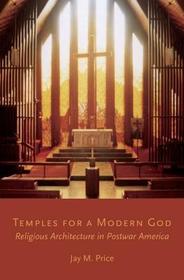
Temples for a Modern God
Religious Architecture in Postwar America
- Publisher's listprice GBP 102.50
-
46 278 Ft (44 075 Ft + 5% VAT)
The price is estimated because at the time of ordering we do not know what conversion rates will apply to HUF / product currency when the book arrives. In case HUF is weaker, the price increases slightly, in case HUF is stronger, the price goes lower slightly.
- Discount 10% (cc. 4 628 Ft off)
- Discounted price 41 651 Ft (39 668 Ft + 5% VAT)
Subcribe now and take benefit of a favourable price.
Subscribe
46 278 Ft

Availability
printed on demand
Why don't you give exact delivery time?
Delivery time is estimated on our previous experiences. We give estimations only, because we order from outside Hungary, and the delivery time mainly depends on how quickly the publisher supplies the book. Faster or slower deliveries both happen, but we do our best to supply as quickly as possible.
Product details:
- Publisher OUP USA
- Date of Publication 10 January 2013
- ISBN 9780199925957
- Binding Hardback
- No. of pages288 pages
- Size 163x236x30 mm
- Weight 590 g
- Language English
- Illustrations 38 b&w halftones 0
Categories
Short description:
After World War II, Americans constructed an unprecedented number of synagogues, churches, cathedrals, chapels, and other structures. The book is one of the first major studies of American religious architecture in the postwar period, and it reveals the diverse and complicated set of issues that emerged just as one of the nation's biggest building booms unfolded. Price argues that the resulting structures, as often mocked as loved, were physical embodiments of an important time in American religious history.
MoreLong description:
Temples for a Modern God is one of the first major studies of American religious architecture in the postwar period, and it reveals the diverse and complicated set of issues that emerged just as one of the nation's biggest building booms unfolded. Jay Price tells the story of how a movement consisting of denominational architectural bureaus, freelance consultants, architects, professional and religious organizations, religious building journals, professional conferences, artistic studios, and specialized businesses came to have a profound influence on the nature of sacred space. Debates over architectural style coincided with equally significant changes in worship practice. Meanwhile, suburbanization and the baby boom required a new type of worship facility, one that had to attract members and serve a social role as much as it had to to honor the Divine. Price uses religious architecture to explore how Mainline Protestantism, Catholicism, Judaism, and other traditions moved beyond their ethnic, regional, and cultural enclaves to create a built environment that was simultaneously intertwined with technology and social change, yet rooted in fluid and shifting sense of tradition. Price argues that these structures, as often mocked as loved, were physical embodiments of a significant, if underappreciated, era in American religious history.
Jay M. Price presents an inspiring history of religious architecture in Northern America By arranging this material chronologically, Price narrates religious history in a dense, informative, yet readable way.
Table of Contents:
Introduction
Chapter 1: The Search for a Better Church Building
Chapter 2: The Postwar House of Worship
Chapter 3: Postwar Religious Building: A Negotiated
Chapter 4: Making a Modern Church Still Look Like a Church
Chapter 5: "Let's Stop Building Cathedrals"
Conclusion: An Unappreciated Legacy
Bibliography

