

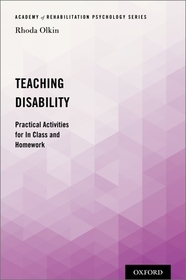
Teaching Disability
Practical Activities for In Class and Homework
Series: Academy of Rehabilitation Psychology Series;
- Publisher's listprice GBP 39.99
-
18 055 Ft (17 195 Ft + 5% VAT)
The price is estimated because at the time of ordering we do not know what conversion rates will apply to HUF / product currency when the book arrives. In case HUF is weaker, the price increases slightly, in case HUF is stronger, the price goes lower slightly.
- Discount 10% (cc. 1 806 Ft off)
- Discounted price 16 249 Ft (15 476 Ft + 5% VAT)
Subcribe now and take benefit of a favourable price.
Subscribe
18 055 Ft

Availability
Estimated delivery time: In stock at the publisher, but not at Prospero's office. Delivery time approx. 3-5 weeks.
Not in stock at Prospero.
Why don't you give exact delivery time?
Delivery time is estimated on our previous experiences. We give estimations only, because we order from outside Hungary, and the delivery time mainly depends on how quickly the publisher supplies the book. Faster or slower deliveries both happen, but we do our best to supply as quickly as possible.
Product details:
- Publisher OUP USA
- Date of Publication 13 October 2021
- ISBN 9780190850661
- Binding Paperback
- No. of pages224 pages
- Size 156x236x11 mm
- Weight 322 g
- Language English 145
Categories
Short description:
This book takes a nonpathological approach to disability as part of diversity rather than as a deficiency, offering 34 activities to help instructors working with this community. The activities are designed to be used in or out of the classroom, in independent or group dynamics, and can be modified for individual need.
MoreLong description:
This book takes a nonpathological approach to disability, viewing it as part of diversity rather than as deficit. The opening chapters introduce basic knowledge of teaching in disability communities, covering attitudes and behaviors that may be difficult for instructors to relate to. Next, the book delves into the three activities sections that increase in difficulty over the course of the book. The activities highlight barriers and psychosocial impediments that hamper progress in disability communities. Designed by an expert educator and clinician who is also an insider in the disability community, each of the 34 activities translate well in classroom environments or as homework, and each can be done individually or in group settings. All activities include a list of required materials, time expectation, goal setting criteria, possible outcomes, and talking and debriefing points for reflection, thereby facilitating effective planning and execution. The activities also recommend possible modifications to adjust the difficulty of the activities. This flexibility makes this a valuable resource for a wider audience of expertise and settings, ranging from introductory to sophisticated readers and users, students and non-students, in classrooms, in workshops, or in other surroundings.
Lastly, the book concludes with a chapter on accessing outcomes, with six measures for evaluating knowledge and skill. Teaching Disability is a well-rounded, highly applicable tool for instructors and students in the disability community.
Table of Contents:
PART A: BACKGROUND AND BASICS
Chapter 1: Introduction for Instructors
Chapter 2: Attitudes, Knowledge and Behavior
PART B: BEGINNING LEVEL EXERCISES
Chapter 3: Exploring the Basics
Chapter 4: Hearing from Insiders
Chapter 5: Laws and How They Affect Everyday Life
Chapter 6: Models of Disability
Chapter 7: Everyday Issues
Chapter 8: Watching Films
PART C: MORE ADVANCED EXERCISES
Chapter 9: Disability in Context of Family, Friends, Community
Chapter 10: Immersion and Activism
PART D: CONCLUSIONS
Chapter 11: Assessing Outcomes

