

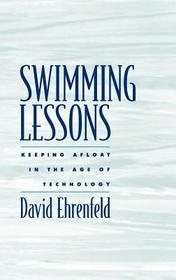
Swimming Lessons
Keeping Afloat in the Age of Technology
- Publisher's listprice GBP 37.99
-
17 152 Ft (16 335 Ft + 5% VAT)
The price is estimated because at the time of ordering we do not know what conversion rates will apply to HUF / product currency when the book arrives. In case HUF is weaker, the price increases slightly, in case HUF is stronger, the price goes lower slightly.
- Discount 10% (cc. 1 715 Ft off)
- Discounted price 15 437 Ft (14 702 Ft + 5% VAT)
Subcribe now and take benefit of a favourable price.
Subscribe
17 152 Ft

Availability
printed on demand
Why don't you give exact delivery time?
Delivery time is estimated on our previous experiences. We give estimations only, because we order from outside Hungary, and the delivery time mainly depends on how quickly the publisher supplies the book. Faster or slower deliveries both happen, but we do our best to supply as quickly as possible.
Product details:
- Publisher OUP USA
- Date of Publication 28 February 2002
- ISBN 9780195148527
- Binding Hardback
- No. of pages272 pages
- Size 236x160x27 mm
- Weight 526 g
- Language English 0
Categories
Short description:
David Ehrenfeld is among the most eloquent writers on ecology and conservation biology. He was the founding editor of the Journal of Conservation Biology, and author of The Arrogance of Humanism and Beginning Again. This new book presents an elegant neo-luddite perspective on the costs to human dignity and potential, of the shrinking of wilderness and the ongoing degradation of the environment. Ehrenfeld ruminates on the specific impacts of shortsighted governmental and economic policies, and of new technologies on human values and communities, tracing the human impacts upon the urban, agricultural and wilderness environments. Ehrenfeld has a unique, unmistakable voice as a major spokesperson for the conservation ethic and the human values implicit in environmentalism and conservation biology. This book should appeal strongly to readers of Ehrenfeld's earlier books and essays, and reach and satisfy a broad constituency on the green end of the political spectrum.
MoreLong description:
David Ehrenfeld is a highly esteemed writer on ecology and conservation biology. The founding editor of The Journal of Conservation Biology and author of The Arrogance of Humanism and Beginning Again, his new book is an elegant study of the cost to human dignity and potential, of the shrinking wilderness and the ongoing degredation of the environment. He ruminates on the impacts of short-sighted governmental and economic policies, and of new technologies on human values and communities, tracing the human impacts upon the urban, agricultural and wilderness environments. Ehrenfeld has a unique, unmistakable voice as a major spokesperson for the conservation ethic and the human values implicit in environmentalism and conservation biology. This book should appeal strongly to readers of Ehrenfeld's earlier books and essays, and reach and satisfy a broad constituency on the green end of the political spectrum.
MoreTable of Contents:
Section 1: The Lies We Live
Brainstorming
Pretending
The Magic of the Internet
Nothing Simple
Sherlock, Nero, and Us
Section 2: Wrecking Our Society--A Manual
Rejecting Gifts
Adaptation
Forecast: Chilly, Overcast, Light Drizzle, No People Left
Pseudocommunities
Obsolescence
Social Evolution Versus Sudden Change
Writing
Section 3: Deadly Economics
Affluence and Austerity
Durable Goods
Spending Our Capital
Saving by Selling
Hot Spots and the Globalization of Conservation
The Gingko and the Stump
The Death Penalty
Section 4: Relating to Nature in a Manmade World
The Vine Cleaners
A Connoisseur of Nature
Death of a Plastic Palm
Scientific Discoveries and Nature's Mysteries
I Reinvent Agriculture
Thinking about Breeds and Species
Teaching Field Ecology
More Field Ecology: Rightofway Island
A Walk in the Woods
Degrees of Intimacy
Section 5. Restoring the Community
The Utopia Fallacy
Traditions
Jane Austen and the World of the Community
Universities and Their Communities
An Invalid's Guide
Swimming Lessons
Bibliography and Suggested Readings

