

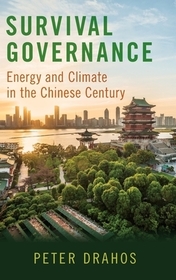
Survival Governance
Energy and Climate in the Chinese Century
- Publisher's listprice GBP 31.99
-
15 283 Ft (14 555 Ft + 5% VAT)
The price is estimated because at the time of ordering we do not know what conversion rates will apply to HUF / product currency when the book arrives. In case HUF is weaker, the price increases slightly, in case HUF is stronger, the price goes lower slightly.
- Discount 10% (cc. 1 528 Ft off)
- Discounted price 13 754 Ft (13 100 Ft + 5% VAT)
Subcribe now and take benefit of a favourable price.
Subscribe
15 283 Ft

Availability
Estimated delivery time: Expected time of arrival: end of January 2026.
Not in stock at Prospero.
Why don't you give exact delivery time?
Delivery time is estimated on our previous experiences. We give estimations only, because we order from outside Hungary, and the delivery time mainly depends on how quickly the publisher supplies the book. Faster or slower deliveries both happen, but we do our best to supply as quickly as possible.
Product details:
- Publisher OUP USA
- Date of Publication 15 April 2021
- ISBN 9780197534755
- Binding Hardback
- No. of pages272 pages
- Size 155x236x27 mm
- Weight 499 g
- Language English 154
Categories
Short description:
To deal with the climate crisis we need a new paradigm of technological and social development aimed at the restoration of ecological systems--the bio-digital energy paradigm. How do we get to this paradigm? The book draws on more than 250 interviews across 17 key countries to present a practical answer this question. We need a strong state to lead. There are four possible leaders--the EU, US, China and India. China is best placed to lead. It is building experimental cities like eco-cities and sponge cities out of which could grow the climate survival governance that the world badly needs.
MoreLong description:
To deal with the climate crisis we need a new paradigm of technological and social development aimed at the restoration of ecological systems--the bio-digital energy paradigm--and China is the world power best positioned to lead this change.
The climate and energy crisis requires a strong state to change the direction, speed, and scale of innovation in world capitalism. There are only a few possible contenders for catalyzing this governance of survival: China, the European Union, India, and the United States. While China is an improbable leader--and in fact the world's biggest emitter of greenhouse gasses--Peter Drahos explains in Survival Governance why this authoritarian state is actually more likely to implement systemic change swiftly and effectively than any other power. Drawing on more than 250 interviews, carried out in 17 countries--including the world's four largest carbon emitters--Drahos shows what China is doing to make its vast urban network sustainable and why all states must work toward a "bio-digital energy paradigm" based on a globalized, city-based network of innovation.
As Drahos explains, America is incapable of reducing the power of its fossil fuel industry. For its part, the European Union's approach is too incremental and slowed by complex internal negotiations to address a crisis that demands a rapid response. India's capacity to be a global leader on energy innovation is questionable. To be sure, China faces hurdles too. Its coal-based industrial system is enormous, and the US, worried about losing technological superiority, is trying to slow China's development. Even so, China is currently urbanizing innovation on a historically unprecedented scale, building eco-cities, hydrogen cities, forest cities, and sponge cities (designed to cope with flooding). This has the potential to move cities into a new relationship with their surrounding ecosystems. China--given the size of its economy and the central government's ability to dictate thoroughgoing policy change--is, despite all of its flaws, presently our best hope for implementing the sort of policy overhaul that can begin to slow climate change.
Drawing on more than 250 interviews, carried out in 17 countries including the world's four largest carbon emitters—Drahos shows what China is doing to make its vast urban network sustainable and why all states must work toward a "bio-digital energy paradigm" based on a globalized, city-based network of innovation.
Table of Contents:
Preface
1. The Argument in Summary
2. Choosing Among Implausible Leaders
3. Technology choices
4. The Geo-Energy Trilemma and its Mis-Management
5. "Winners" and "Losers" in Hotter Worlds
6. China's Limits to Growth
7. Backing the Bio-Digital Energy Paradigm?
8. City Pathways to the Bio-Digital Energy Paradigm
9. India, the Janus Energy Sovereign
10. Survival Governance

