

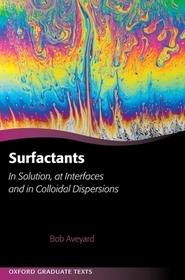
Surfactants
In Solution, at Interfaces and in Colloidal Dispersions
- Publisher's listprice GBP 80.00
-
36 120 Ft (34 400 Ft + 5% VAT)
The price is estimated because at the time of ordering we do not know what conversion rates will apply to HUF / product currency when the book arrives. In case HUF is weaker, the price increases slightly, in case HUF is stronger, the price goes lower slightly.
- Discount 10% (cc. 3 612 Ft off)
- Discounted price 32 508 Ft (30 960 Ft + 5% VAT)
Subcribe now and take benefit of a favourable price.
Subscribe
36 120 Ft

Availability
Estimated delivery time: In stock at the publisher, but not at Prospero's office. Delivery time approx. 3-5 weeks.
Not in stock at Prospero.
Why don't you give exact delivery time?
Delivery time is estimated on our previous experiences. We give estimations only, because we order from outside Hungary, and the delivery time mainly depends on how quickly the publisher supplies the book. Faster or slower deliveries both happen, but we do our best to supply as quickly as possible.
Product details:
- Publisher OUP Oxford
- Date of Publication 15 October 2019
- ISBN 9780198828600
- Binding Hardback
- No. of pages576 pages
- Size 247x178x34 mm
- Weight 1258 g
- Language English
- Illustrations 297 grayscale and 57 color line drawings, 16 grayscale halftones and 7 color halftones 0
Categories
Short description:
Surfactants are in everyday products such as detergents, foodstuffs, and cosmetics. Their molecules have one part which is water soluble and another which is not. This gives them two valuable properties: they adsorb at surfaces, and they stick together in water. This book treats the physical chemistry and physics underlying surfactants.
MoreLong description:
Surfactants... today you have probably eaten some, or rubbed others on your body. Plants, animals (including you) and microorganisms make them, and many everyday products (e.g. detergents, cosmetics, foodstuffs) contain them. Surfactant molecules have one part which is soluble in water and another which is not. This gives surfactant molecules two valuable properties: 1) they adsorb at surfaces (e.g. of an oil droplet in water), and 2) they stick together (aggregate) in water. The aggregates (micelles) are able to dissolve materials not soluble in water alone, and adsorbed surfactant layers, at the surfaces of particles or (say) oil droplets in water, stop the particles or drops sticking together. This is why stable emulsions such as milk do not separate into layers. This book treats the basic physical chemistry and physics underlying the behaviour of surfactant systems.
In this book, you will first learn about some background material including hydrophobic hydration, interfacial tension and capillarity (Section I). Discussion of surfactant adsorption at liquid/fluid and solid/liquid interfaces is given in Section II, and includes thermodynamics of adsorption, dynamic and rheological aspects of liquid interfaces and the direct characterisation of surfactant monolayers. In Section III, a description is given of surfactant aggregation to give micelles, lyotropic liquid crystals, microemulsions and Winsor systems. There follows a discussion of surface forces and the way they confer stability on lyophobic colloids and thin liquid films (Section IV). Various dispersions stabilised by adsorbed surfactant or polymer (including solid in liquid dispersions, emulsions and foams) are considered in Section V. The wetting of solids and liquids is explored in Section VI. Like surfactants, small solid particles can adsorb at liquid/fluid interfaces, form monolayers and stabilise emulsions and foams. Such behaviour is covered in Section VII. It is assumed the reader has a knowledge of undergraduate physical chemistry, particularly chemical thermodynamics, and of simple physics. Mathematics (elementary algebra and calculus) is kept at a level consistent with the straightforward derivation of many of the equations presented.
I recommend this book not only to undergraduates, graduates and PhD students in colloid and interface science and related areas, but also to researchers in this field. Even established experts will find new insights into the various areas of surfactant science. I am sure readers will be inspired by the way the world of surfactants and their behaviour is presented here.
Table of Contents:
SECTION I BACKGROUND
What are surfactants?
Oil and water do not mix: hydrophobic hydration
Capillarity, wetting and surface (interfacial) tension
SECTION II ADSORPTION OF SURFACTANTS
Adsorption of surfactants at liquid interfaces: thermodynamics
Adsorption of surfactants at liquid/vapour and liquid/liquid interfaces
Dynamic aspects of liquid interfaces
Adsorption of surfactants at solid/liquid interfaces
Direct characterisation of adsorbed surfactant layers
SECTION III: AGGREGATION OF SURFACTANTS IN SOLUTION
Aggregation of surfactants in aqueous systems
Surfactants in systems with oil and water, including microemulsions
Section IV: SURFACE FORCES AND THIN LIQUID FILMS
Surface forces and colloidal behaviour
Thin liquid films
SECTION V: DISPERSIONS STABILISED BY SURFACTANTS
Dispersions of solids in liquids
Emulsions and Foams
Rheology of colloids
SECTION VI: WETTING OF SOLIDS AND LIQUIDS
Wetting
SECTION VII: SYSYEMS WITH PARTICLES AT LIQUID INTERFACES
Particles in Monolayers and Thin Liquid Films
Emulsions stabilised by solid particles
THEMES AND CONNECTIONS

