

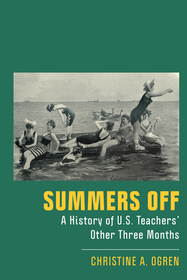
Summers Off? – A History of U.S. Teachers` Other Three Months
A History of U.S. Teachers' Other Three Months
Series: New Directions in the History of Education;
- Publisher's listprice GBP 33.00
-
15 765 Ft (15 015 Ft + 5% VAT)
The price is estimated because at the time of ordering we do not know what conversion rates will apply to HUF / product currency when the book arrives. In case HUF is weaker, the price increases slightly, in case HUF is stronger, the price goes lower slightly.
- Discount 10% (cc. 1 577 Ft off)
- Discounted price 14 189 Ft (13 514 Ft + 5% VAT)
Subcribe now and take benefit of a favourable price.
Subscribe
15 765 Ft

Availability
Estimated delivery time: In stock at the publisher, but not at Prospero's office. Delivery time approx. 3-5 weeks.
Not in stock at Prospero.
Why don't you give exact delivery time?
Delivery time is estimated on our previous experiences. We give estimations only, because we order from outside Hungary, and the delivery time mainly depends on how quickly the publisher supplies the book. Faster or slower deliveries both happen, but we do our best to supply as quickly as possible.
Product details:
- Publisher John Wiley & Sons
- Date of Publication 13 November 2025
- Number of Volumes Paperback
- ISBN 9781978831742
- Binding Paperback
- No. of pages282 pages
- Size 234x156x28 mm
- Weight 428 g
- Language English
- Illustrations 12 B-W images 670
Categories
Long description:
Since the nine-month school year became common in the United States during the 1880s, schoolteachers have never really had summers off. Administrators instructed them to rest, as well as to study and travel, in the interest of creating a compliant workforce. Teachers, however, adapted administrators’ directives to pursue their own version of professionalization and to ensure their financial well-being. Summers Off explores teachers’ summer experiences between the 1880s and 1930s in institutes and association meetings; sessions at teachers colleges, Black colleges, and prestigious universities; work for wages or their family; tourism in the U.S. and Europe; and activities intended to be restful. This heretofore untold history reveals how teachers utilized the geographical and psychological distance from the classroom that summer provided, to enhance not only their teaching skills but also their professional and intellectual independence, their membership in the middle class, and, in the cases of women and Black teachers, their defiance of gender and race hierarchies.
More
