

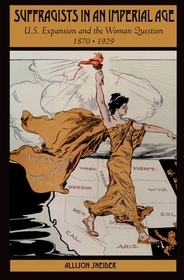
Suffragists in an Imperial Age
U.S. Expansion and the Woman Question, 1870-1929
- Publisher's listprice GBP 28.99
-
13 088 Ft (12 465 Ft + 5% VAT)
The price is estimated because at the time of ordering we do not know what conversion rates will apply to HUF / product currency when the book arrives. In case HUF is weaker, the price increases slightly, in case HUF is stronger, the price goes lower slightly.
- Discount 10% (cc. 1 309 Ft off)
- Discounted price 11 779 Ft (11 219 Ft + 5% VAT)
Subcribe now and take benefit of a favourable price.
Subscribe
13 088 Ft

Availability
printed on demand
Why don't you give exact delivery time?
Delivery time is estimated on our previous experiences. We give estimations only, because we order from outside Hungary, and the delivery time mainly depends on how quickly the publisher supplies the book. Faster or slower deliveries both happen, but we do our best to supply as quickly as possible.
Product details:
- Publisher OUP USA
- Date of Publication 21 February 2008
- ISBN 9780195321173
- Binding Paperback
- No. of pages224 pages
- Size 156x234x11 mm
- Weight 313 g
- Language English
- Illustrations 4 maps 0
Categories
Short description:
Suffragists in an Imperial Age demonstrates how seemingly disparate conversations about the physical boundaries of national territory and the genered boundaries of political space overlapped and inflected each other during post-Civil War efforts to rebuild the nation in new terms. This book argues that US expansion was crucial to the development of the post-bellum US woman suffrage movement and shows how federal discussions of citizenship and voting rights in the context of creating territorial governments in the continental West and, after the Spanish-American War, in the Caribbean and the Pacific, created space on the Congressional calendar for suffragists to instigate debate on the woman question. In the negotiation of global power relations across the twentieth century and into the present, political rights for women continues to function as a marker of success for experiments in expanding democracy, as well as a bargaining chip for reasserting some degree of political independence for men. This book shows how by 1929, suffragists were on the verge of making women's voting rights an integral part of US colonial policy, and adding votes for women to the list of markers symbolizing the achievement of "civilization" in US colonies.
MoreLong description:
In 1899, Carrie Chapman Catt, who succeeded Susan B. Anthony as head of the National American Women Suffrage Association, argued that it was the "duty" of U.S. women to help lift the inhabitants of its new island possessions up from "barbarism" to "civilization," a project that would presumably demonstrate the capacity of U.S. women for full citizenship and political rights. Catt, like many suffragists in her day, was well-versed in the language of empire, and infused the cause of suffrage with imperialist zeal in public debate.
Unlike their predecessors, who were working for votes for women within the context of slavery and abolition, the next generation of suffragists argued their case against the backdrop of the U.S. expansionism into Indian and Mormon territory at home as well as overseas in the Philippines, Puerto Rico, and Hawaii. In this book, Allison L. Sneider carefully examines these simultaneous political movements--woman suffrage and American imperialism--as inextricably intertwined phenomena, instructively complicating the histories of both.
Sneider has written an innovative study of the intersections of suffrage and expansionism.

