

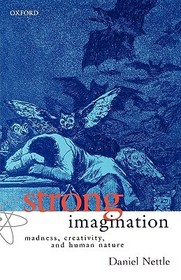
Strong Imagination
Madness, Creativity and Human Nature
- Publisher's listprice GBP 47.49
-
21 441 Ft (20 420 Ft + 5% VAT)
The price is estimated because at the time of ordering we do not know what conversion rates will apply to HUF / product currency when the book arrives. In case HUF is weaker, the price increases slightly, in case HUF is stronger, the price goes lower slightly.
- Discount 10% (cc. 2 144 Ft off)
- Discounted price 19 297 Ft (18 378 Ft + 5% VAT)
Subcribe now and take benefit of a favourable price.
Subscribe
21 441 Ft

Availability
printed on demand
Why don't you give exact delivery time?
Delivery time is estimated on our previous experiences. We give estimations only, because we order from outside Hungary, and the delivery time mainly depends on how quickly the publisher supplies the book. Faster or slower deliveries both happen, but we do our best to supply as quickly as possible.
Product details:
- Publisher OUP Oxford
- Date of Publication 1 March 2001
- ISBN 9780198507062
- Binding Hardback
- No. of pages248 pages
- Size 227x146x18 mm
- Weight 460 g
- Language English
- Illustrations 3 halftones, 7 line figures 0
Categories
Short description:
Writing for the general reader, Daniel Nettle tackles the question of why madness exists. He shows that there is, as long suspected, a link between madness and creative genius. He thus argues that the traits that lie behind madness have evolved because they have psychological benefits as well as psychological costs.
MoreLong description:
Madness is the central mystery of the human psyche. Our minds evolved to give us a faithful understanding of reality, to allow us to integrate into our communities, and to help us adapt our behaviour to our environment. Yet in serious mental illness, the mind does exactly the opposite of these things. The sufferer builds castles of imaginative delusion, fails to adapt, and becomes a stranger among his own people. Yet mental illness is no marginal phenomenon: it is found in all societies and all historical epochs, and the genes that underlie it are quite common. Furthermore, the traits that identify the madman are found in attenuated form in normal thinking and feeling. The persistence of madness, then, is a terrible puzzle from both an evolutionary and a human point of view. In A Midsummer Night's Dream, Shakespeare suggested a link between madness and artistic creativity: 'The lunatic, the lover, and the poet', he wrote, 'Are of imagination all compact'. Recent studies have shown that there is indeed a connection. Rates of mental illness are hugely elevated in the families of poets, writers and artists, suggesting that the same genes, the same temperaments, and the same imaginative capacities are at work in insanity and in creative ability. Thus the reason madness continues to exist is that the traits behind it have psychological benefits as well as psychological costs. In Strong Imagination, Daniel Nettle explores the nature of mental illness, the biological mechanisms that underlie it, and its link to creative genius. He goes on to consider the place of both madness and creative imagination in the evolution of our species.
lucid, imaginative unravelling of insanity
Table of Contents:
Introduction
From disease to difference and back again
From Nature to Nurture and back again
This taint of blood
The storm-tossed soul
The sleep of reason produces monsters
Such tricks hath strong imagination
The lunatic, the lover and the poet
Civilization and its discontents
Staying sane
Epilogue
Further reading; References; Index

