

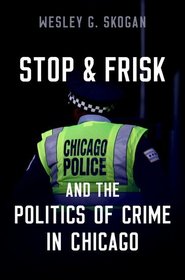
Stop & Frisk and the Politics of Crime in Chicago
- Publisher's listprice GBP 26.99
-
12 185 Ft (11 605 Ft + 5% VAT)
The price is estimated because at the time of ordering we do not know what conversion rates will apply to HUF / product currency when the book arrives. In case HUF is weaker, the price increases slightly, in case HUF is stronger, the price goes lower slightly.
- Discount 10% (cc. 1 219 Ft off)
- Discounted price 10 967 Ft (10 445 Ft + 5% VAT)
Subcribe now and take benefit of a favourable price.
Subscribe
12 185 Ft

Availability
Estimated delivery time: In stock at the publisher, but not at Prospero's office. Delivery time approx. 3-5 weeks.
Not in stock at Prospero.
Why don't you give exact delivery time?
Delivery time is estimated on our previous experiences. We give estimations only, because we order from outside Hungary, and the delivery time mainly depends on how quickly the publisher supplies the book. Faster or slower deliveries both happen, but we do our best to supply as quickly as possible.
Product details:
- Publisher OUP USA
- Date of Publication 9 February 2023
- ISBN 9780197675069
- Binding Paperback
- No. of pages280 pages
- Size 237x154x16 mm
- Weight 413 g
- Language English
- Illustrations 42 b/w line drawings and 5 tables 261
Categories
Short description:
In Stop & Frisk and the Politics of Crime in Chicago, Wesley G. Skogan offers a comprehensive analysis of the stop & frisk policy, its origins as Chicago's predominant strategy for responding to violent crime, and its impact on public opinion. Drawing on a crime database of over 14 million incidents, interviews with 1,450 Chicagoans and 714 police officers, and the author's 30 years of studying, talking to, and riding along with Chicago police officers, Skogan looks at the inner workings of police departments and the history and politics of crime prevention that motivate these policies. Rather than looking at individual stops and how they are handled, he argues for considering stop & frisk as an organizational strategy, intimately tied to the move from reactive to preventive policing.
MoreLong description:
A comprehensive analysis of the stop & frisk policy, its origins as Chicago's predominant strategy for responding to violence, and its impact on crime and public opinion.
Stop & frisk has drawn a great deal of attention--and heated criticism--in recent years, for racial bias in its application and for the often violent and sometimes fatal nature of these encounters. In Stop & Frisk and the Politics of Crime in Chicago, Wesley G. Skogan offers a comprehensive analysis of the stop-and-frisk policy, its origins as Chicago's predominant strategy for responding to violence, and its impact on crime and public opinion. Drawing on a crime database of over 14 million incidents, interviews with 1,450 Chicagoans and 714 police officers, and the author's 30 years of studying, talking to, and riding along with Chicago police officers, Skogan looks at the inner workings of police departments and the history and politics of crime prevention that motivate these policies. Rather than looking at individual stops and how they are handled, he argues for considering stop & frisk as an organizational strategy, intimately tied to the move from reactive to preventive policing. Examining one of America's predominant crime control strategies, this book provides an essential analysis of the origins, implementation, and effects of stop & frisk in Chicago and on urban policing in general.
What was the cost of stop & search preventing an estimated 703 murders over 180 months in Chicago (4 murders per month), primarily in minority areas? Skogan's unprecedented analysis allows us to ask whether that price could be lower, avoiding both under-policing and over-policing for 'just right' targeting of the most volatile strategy police use against weapons crime.
Table of Contents:
Acknowledgments
Chapter 1: The Era of Stop & Frisk
Chapter 2: Twenty-first Century Crime
Chapter 3: Stop & Frisk as an Organizational Strategy
Chapter 4: What Happens During Stop & Frisks?
Chapter 5: Police Versus the Community?
Chapter 6: The Collapse of Stop & Frisk
Chapter 7: The Great Crime Spike of 2016
Chapter 8: Assessing Stop & Frisk
Epilogue
Data Appendix
References
Index

