

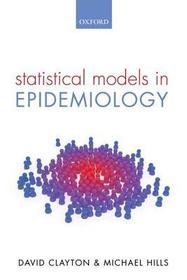
Statistical Models in Epidemiology
- Publisher's listprice GBP 66.00
-
29 799 Ft (28 380 Ft + 5% VAT)
The price is estimated because at the time of ordering we do not know what conversion rates will apply to HUF / product currency when the book arrives. In case HUF is weaker, the price increases slightly, in case HUF is stronger, the price goes lower slightly.
- Discount 10% (cc. 2 980 Ft off)
- Discounted price 26 819 Ft (25 542 Ft + 5% VAT)
Subcribe now and take benefit of a favourable price.
Subscribe
29 799 Ft

Availability
printed on demand
Why don't you give exact delivery time?
Delivery time is estimated on our previous experiences. We give estimations only, because we order from outside Hungary, and the delivery time mainly depends on how quickly the publisher supplies the book. Faster or slower deliveries both happen, but we do our best to supply as quickly as possible.
Product details:
- Publisher OUP Oxford
- Date of Publication 17 January 2013
- ISBN 9780199671182
- Binding Paperback
- No. of pages384 pages
- Size 233x177x19 mm
- Weight 578 g
- Language English
- Illustrations 50 b/w line drawings 0
Categories
Short description:
This self-contained account of the statistical basis of epidemiology has been written for those with a basic training in biology. No previous knowledge of the subject is assumed and mathematics is deliberately kept at a manageable level. Based on a highly successful course, this book explains the essential statistics for all epidemiologists.
MoreLong description:
This self-contained account of the statistical basis of epidemiology has been written specifically for those with a basic training in biology, therefore no previous knowledge is assumed and the mathematics is deliberately kept at a manageable level. The authors show how all statistical analysis of data is based on probability models, and once one understands the model, analysis follows easily.
In showing how to use models in epidemiology the authors have chosen to emphasize the role of likelihood, an approach to statistics which is both simple and intuitively satisfying. More complex problems can then be tackled by natural extensions of the simple methods. Based on a highly successful course, this book explains the essential statistics for all epidemiologists.
Unlike many textbooks in epidemiology, there is no long wordy preamble. The characteristic style is set straight away. The book is also highly successful in presenting a unified approach. What is also striking, is that the authors have managed to say something useful and clear about many of the all too numerous minor problems that are inevitably encountered in practice. In my view this is simply an excellent text.
Table of Contents:
I. Probability Models and Likelihood
Probability models
Conditional probability models
Likelihood
Consecutive follow-up intervals
Rates
Time
Competing risks and selection
The Gaussian probability model
Approximate likelihoods
Likelihood, probability, and confidence
Null hypotheses and p-values
Small studies
Likelihoods for the rate ratio
Confounding and standardization
Comparison of rates within strata
Case-control studies
Likelihoods for the odds ratio
Comparison of odds within strata
Individually matched case-control studies
Tests for trend
The size of investigations
II. Regression Models
Introduction to regression models
Poission and logistic regression
Testing hypotheses
Models for dose-response
More about interaction
Choice and interpretation of models
Additivity and synergism
Conditional logistic regression
Cox's regression analysis
Time-varying explanatory variables
Three examples
Nested case-control studies
Gaussian regression models
Postscript
III. Appendices
A. Exponentials
B. Some basic calculus
C. Approximate profile likelihoods
D. Table of the Chi-squared distribution
Index

