

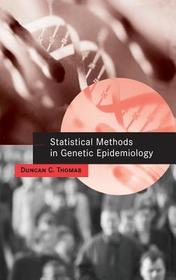
Statistical Methods in Genetic Epidemiology
- Publisher's listprice GBP 91.00
-
43 475 Ft (41 405 Ft + 5% VAT)
The price is estimated because at the time of ordering we do not know what conversion rates will apply to HUF / product currency when the book arrives. In case HUF is weaker, the price increases slightly, in case HUF is stronger, the price goes lower slightly.
- Discount 10% (cc. 4 348 Ft off)
- Discounted price 39 128 Ft (37 265 Ft + 5% VAT)
Subcribe now and take benefit of a favourable price.
Subscribe
43 475 Ft

Availability
printed on demand
Why don't you give exact delivery time?
Delivery time is estimated on our previous experiences. We give estimations only, because we order from outside Hungary, and the delivery time mainly depends on how quickly the publisher supplies the book. Faster or slower deliveries both happen, but we do our best to supply as quickly as possible.
Product details:
- Publisher OUP USA
- Date of Publication 11 March 2004
- ISBN 9780195159394
- Binding Hardback
- No. of pages464 pages
- Size 239x164x26 mm
- Weight 798 g
- Language English
- Illustrations numerous line illustrations 0
Categories
Short description:
This balanced and well-integrated text gives a lucid overview of the entire process of genetic epidemiology, from familial aggregation through segregation, likage, and association studies. It is illustrated throughout with examples from the literature on cancer genetics. Statistical concepts are developed in depth, but with a focus on applications. Introductory chapters on molecular biology, Mendelian genetics, epidemiology, statistics, and population genetics are included. Oriented to graduate students in biostatistics, epidemiology, and human genetics, the book will also be a useful reference for researchers. It gives equal emphasis to study designs and data analysis.
MoreLong description:
This well-organized and clearly written text has a unique focus on methods of identifying the joint effects of genes and environment on disease patterns. It follows the natural sequence of research, taking readers through the study designs and statistical analysis techniques for determining whether a trait runs in families, testing hypotheses about whether a familial tendency is due to genetic or environmental factors or both, estimating the parameters of a genetic model, localizing and ultimately isolating the responsible genes, and finally characterizing their effects in the population. Examples from the literature on the genetic epidemiology of breast and colorectal cancer, among other diseases, illustrate this process. Although the book is oriented primarily towards graduate students in epidemiology, biostatistics and human genetics, it will also serve as a comprehensive reference work for researchers. Introductory chapters on molecular biology, Mendelian genetics, epidemiology, statistics, and population genetics will help make the book accessible to those coming from one of these fields without a background in the others. It strikes a good balance between epidemiologic study designs and statistical methods of data analysis.
IStatistical Methods in Environmental Epidemiology is primed to be a valuable resource for a wide range of audiences. The book provides a flexible foundation for an introductory course and can easily be supplemented with additional dashes of theory, computing, or case studies as needed for the particular venue. We are thankful to the book's sole author, whose substantial effort has produced a broad-reaching and forward-looking contribution to environmental epidemiology.
Table of Contents:
Overview of genetic epidemiology
Basic concepts of molecular genetics
Principles of Mendelian inheritance
Basic epidemiologic and statistical principles
Familial aggregation
Segregation analysis
Linkage analysis
Principles of population genetics
Testing candidate gene associations
Linkage disequilibrium mapping
Gene characterization
Tying it all together: the genetic epidemiology of colorectal cancer
Glossary

