

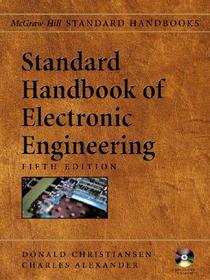
Standard Handbook of Electronic Engineering, 5th Edition
Series: Handbook;
- Publisher's listprice GBP 89.39
-
40 359 Ft (38 437 Ft + 5% VAT)
The price is estimated because at the time of ordering we do not know what conversion rates will apply to HUF / product currency when the book arrives. In case HUF is weaker, the price increases slightly, in case HUF is stronger, the price goes lower slightly.
- Discount 10% (cc. 4 036 Ft off)
- Discounted price 36 323 Ft (34 593 Ft + 5% VAT)
Subcribe now and take benefit of a favourable price.
Subscribe
40 359 Ft

Availability
Permanently out of stock
Why don't you give exact delivery time?
Delivery time is estimated on our previous experiences. We give estimations only, because we order from outside Hungary, and the delivery time mainly depends on how quickly the publisher supplies the book. Faster or slower deliveries both happen, but we do our best to supply as quickly as possible.
Product details:
- Edition number 5
- Publisher McGraw-Hill Education
- Date of Publication 16 January 2005
- ISBN 9780071384216
- Binding Book
- No. of pages pages
- Size 236x195x61 mm
- Weight 2046 g
- Language English 0
Categories
Long description:
The Standard Handbook of Electronics Engineering has defined its field for over thirty years. Spun off in the 1960’s from Fink’s Standard Handbook of Electrical Engineering, the Christiansen book has seen its markets grow rapidly, as electronic engineering and microelectronics became the growth engine of digital computing. The EE market has now undergone another seismic shift—away from computing and into communications and media. The Handbook will retain much of its evergreen basic material, but the key applications sections will now focus upon communications, networked media, and medicine—the eventual destination of the majority of graduating EEs these days.
The Standard Handbook of Electronics Engineering has defined its field for over thirty years. Spun off in the 1960’s from Fink’s Standard Handbook of Electrical Engineering, the Christiansen book has seen its markets grow rapidly, as electronic engineering and microelectronics became the growth engine of digital computing. The EE market has now undergone another seismic shift—away from computing and into communications and media. The Handbook will retain much of its evergreen basic material, but the key applications sections will now focus upon communications, networked media, and medicine—the eventual destination of the majority of graduating EEs these days.

