

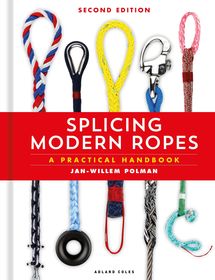
Splicing Modern Ropes 2nd edition
A Practical Handbook
- Publisher's listprice GBP 22.00
-
9 933 Ft (9 460 Ft + 5% VAT)
The price is estimated because at the time of ordering we do not know what conversion rates will apply to HUF / product currency when the book arrives. In case HUF is weaker, the price increases slightly, in case HUF is stronger, the price goes lower slightly.
- Discount 20% (cc. 1 987 Ft off)
- Discounted price 7 946 Ft (7 568 Ft + 5% VAT)
- Discount is valid until: 30 June 2026
Subcribe now and take benefit of a favourable price.
Subscribe
9 933 Ft

Availability
Estimated delivery time: In stock at the publisher, but not at Prospero's office. Delivery time approx. 3-5 weeks.
Not in stock at Prospero.
Why don't you give exact delivery time?
Delivery time is estimated on our previous experiences. We give estimations only, because we order from outside Hungary, and the delivery time mainly depends on how quickly the publisher supplies the book. Faster or slower deliveries both happen, but we do our best to supply as quickly as possible.
Product details:
- Edition number 2
- Publisher Bloomsbury Publishing (UK)
- Date of Publication 13 February 2025
- Number of Volumes Hardback
- ISBN 9781399417266
- Binding Hardback
- No. of pages192 pages
- Size 248x194x20 mm
- Weight 801 g
- Language English
- Illustrations Over 450 colour photographs and diagrams throughout 570
Categories
Long description:
The definitive guide to making strong, reliable splices in braided rope, using step-by-step photographs and clear instructions to help readers master this important but tricky skill.
For any seafarer, splicing rope is an essential skill. But the traditional 3-strand rope is fast disappearing. So how do you splice braided rope?
This is the ultimate guide to this crucial knowledge. Most of the techniques are easy to master - and also fun to do. See why splices are better - and stronger - than knots or shackles for joining or shortening rope, and follow the photographs and steps to find out how to splice efficiently.
In this fully updated second edition, you will learn how to:
? Select ropes in the materials that best suit your on-board requirements
? Customise your ropes to make your setup easier and safer
? Optimise your deck layout and save weight on board
? Taper your sheets for ease of handling
? Splice an extra cover on your ropes to give better grip in clutches, avoid chafe and make them last longer
While a knot can reduce the strength of a rope by as much as 50%, a well-spliced rope loses only 5-10%. The techniques, insights and suggestions within these pages will be invaluable to all boaters, whether recreational or commercial. This refreshed new edition has been updated to take in to account developments in fibre technology and includes new splicing techniques and updated photography.
Table of Contents:
Introduction
1. Synthetic fibres
Developments
Technical features
Breaking strain
Safe working load
Stretch
Creep
Synthetic fibres used for ropes
Polyester
Polyamide
Polypropylene
HMPE (Dyneema/Spectra)
LCP (Vectran)
PBO (Zylon)
Aramid (Kevlar/ Technora)
2. Construction of ropes
Twisted ropes
Single braid ropes
Double braid ropes
Braided sleeve with a core of twisted strands or parallel fibres
Additional adjustments
3. Which type of rope?
Sheets and halyards
Materials
Diameter and tensile strength
Length
Mooring lines
Diameter
Length
Ropes combined with camcleats
Maintenance and troubleshooting
Inspection
Friction and wear
Rope does not hold in camcleats
Twisted ropes
Cleaning ropes
4. Before you start
Splicing tools
Splicing technique and core materials
The size of the eye
How to remove a core from the sleeve
'Tapering' the ends of a rope
'Milking' the sleeve
Long bury splicing
5. Eye splice in laid ropes
Three-strand rope
Eight-strand rope
6. Eye splice in polyester ropes
Double braid rope
Rope with a laid core
Rope with parallel fibres in the core
7. Eye splice in Dyneema ropes
Single braid rope
Basic method
Method for empty Dyneema sleeves with a non-slip fibre
Lock splice
Double braid rope
Without using the sleeve
Using the sleeve
Double layer sleeve
8. Dyneema shackles
Soft shackles
Type 1
Type 2
Integral
Soft shackle knot
9. Weight savings and tapering
Tapering a doubled braided Dyneema rope
Joining two single braid ropes
Joining steel wire with double braid polyester
Joining a single braid Dyneema rope with double braid polyester
10. Thickening and strengthening
Splicing or sewing in an extra sleeve
Splicing in an extra sleeve
Sewing in an extra sleeve
Splicing in an extra core
11. Continuous loops
Double braid polyester
For equal thickness, spliced without the core
For strength, spliced with the core
Single braid Dyneema
Basic loop
Loop with sleeve
Double braid Dyneema
12. Whippings
Double stitched whippings for braid ropes
Common whipping
Whipping for a three-strand laid rope
13. Reeving of new halyards
Reeving eye ('Flemish eye')
Reeving loop with whipping
14. Splicing tools
Using a soft needle
How to make a soft needle
Appendices
1 Features of synthetic fibres: a comparison
2 Diameters and breaking strains of ropes
Calculating breaking strains for sheets and halyards
Guidelines for diameters of sheets and halyards
Guidelines for diameters of mooring lines

