

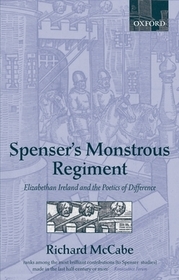
Spenser's Monstrous Regiment
Elizabethan Ireland and the Poetics of Difference
- Publisher's listprice GBP 48.99
-
22 118 Ft (21 065 Ft + 5% VAT)
The price is estimated because at the time of ordering we do not know what conversion rates will apply to HUF / product currency when the book arrives. In case HUF is weaker, the price increases slightly, in case HUF is stronger, the price goes lower slightly.
- Discount 10% (cc. 2 212 Ft off)
- Discounted price 19 906 Ft (18 959 Ft + 5% VAT)
Subcribe now and take benefit of a favourable price.
Subscribe
22 118 Ft

Availability
printed on demand
Why don't you give exact delivery time?
Delivery time is estimated on our previous experiences. We give estimations only, because we order from outside Hungary, and the delivery time mainly depends on how quickly the publisher supplies the book. Faster or slower deliveries both happen, but we do our best to supply as quickly as possible.
Product details:
- Publisher OUP Oxford
- Date of Publication 7 July 2005
- ISBN 9780199282043
- Binding Paperback
- No. of pages330 pages
- Size 216x139x18 mm
- Weight 480 g
- Language English
- Illustrations 12 b/w 0
Categories
Short description:
Spenser's Monstrous Regiment is a stimulating and scholarly account of how the experience of living and writing in Ireland qualified Spenser's attitude towards female regiment and challenged his notions of English nationhood. Including a trenchant discussion of the influence of colonialism upon the structure, themes, imagery, and language of Spenser's poetry, this study of Spenser's canon to engage with primary Gaelic materials in its assessment of his relationship with native Irish and Old English culture. It also provides the first detailed analysis of his association with Lord Grey through examination of the secretarial letters currently held in the PRO.
MoreLong description:
In this important study of Spenser and nationhood - the first to contextualize Spenser's response to the Irish colonial situation by reference to contemporary Gaelic literature - Richard McCabe examines the poet's canon within the dual contexts of imperial aspiration and female 'regiment'. He shows how the experience of writing from Ireland, where the queen's influence repeatedly frustrated the expansionist ambitions of New English settlers, intensified Spenser's sense of alienation from female sovereignty and led to the remarkable fusion of colonial and sexual anxieties evident in The Faerie Queene's pervasive images of anti-heroic emasculation. At the same time the paradoxical attempt to impose civility through violence compromised the poem's moral vision and problematized its conception of national identity. The attempt to create an English myth of origin coincided uneasily with the need to discredit its Gaelic counterpart, as formulated in such works as the Lebor Gabála Érenn, while the perceived 'degeneration' of Old English families within the Pale confounded the ethnic distinctions upon which the colonial enterprise had come to rest and challenged the validity of all nationalist 'myth'. By drawing upon a wide range of Gaelic poets, historians, and polemicists, McCabe seeks to recover the voices that the dialectical format of A View of the Present State of Ireland is designed to exclude and to demonstrate how the Irish dimension of The Faerie Queene provides a dark, but aesthetically enhancing subtext to the poetics of national celebration.
Review from previous edition Two distinctive strengths make this book especially original. First, McCabe's knowledge of Irish language and literature provides a richer context, compensating for the "rigidly anglophone" limitations of recent scholarship. Second, McCabe challenges prevailing assumptions about art's relationship to ideology ...fascinating.
Table of Contents:
Introduction: Beyond the Pale
I. The Imperial Theme
Arms and the Woman
Spenser and the Rival Poets
II. 'Salvagesse sans finesse'
'Salvage Nacion'
'Salvage Knight'
III. The Faerie Queene^ (1590)
St George for Ireland
Sins of Difference
Noble Britons, Savage Scyths
IV. Dialogues of Displacement
Colin Clout's Other Island
Irenius's Mother Tongue
V. The Faerie Queene (1596)
'Friendships Faultie Guile'
Poetic Justice
Savage Courtesy
VI. Spenser's Ireland 1609-1650
Diana's Spite
The Response to A View

