

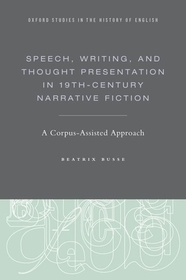
Speech, Writing, and Thought Presentation in 19th-Century Narrative Fiction
A Corpus-Assisted Approach
Series: Oxford Studies in the History of English;
- Publisher's listprice GBP 70.00
-
31 605 Ft (30 100 Ft + 5% VAT)
The price is estimated because at the time of ordering we do not know what conversion rates will apply to HUF / product currency when the book arrives. In case HUF is weaker, the price increases slightly, in case HUF is stronger, the price goes lower slightly.
- Discount 10% (cc. 3 161 Ft off)
- Discounted price 28 445 Ft (27 090 Ft + 5% VAT)
Subcribe now and take benefit of a favourable price.
Subscribe
31 605 Ft

Availability
printed on demand
Why don't you give exact delivery time?
Delivery time is estimated on our previous experiences. We give estimations only, because we order from outside Hungary, and the delivery time mainly depends on how quickly the publisher supplies the book. Faster or slower deliveries both happen, but we do our best to supply as quickly as possible.
Product details:
- Publisher OUP USA
- Date of Publication 10 December 2020
- ISBN 9780190212360
- Binding Hardback
- No. of pages252 pages
- Size 157x239x22 mm
- Weight 476 g
- Language English 61
Categories
Short description:
This book investigates speech, writing, and thought presentation in a corpus of 19th-century narrative fiction. Beatrix Busse develops a new corpus-stylistic approach for analyzing and automatically identifying historical strategies of discourse presentation. On the basis of the identification of these diachronic patterns and their positioning in cultural-historical context, Busse shows how discourse presentation furthers narrative progression and shapes readers' expectations.
MoreLong description:
Reference to or quotation from someone's speech, thoughts, or writing is a key component of narrative. These reports further a narrative, make it more interesting, natural, and vivid, ask the reader to engage with it, and reflect historical cultural understandings of modes of discourse presentation. To a large extent, the way we perceive a story depends on the ways it presents discourse, and along with it, speech, writing, and thought.
In this book, Beatrix Busse investigates speech, writing, and thought presentation in a corpus of 19th-century narrative fiction including Frankenstein, Jane Eyre, Wuthering Heights, Oliver Twist, and many others. At the intersection between corpus linguistics and stylistics, this book develops a new corpus-stylistic approach for systematically analyzing the different narrative strategies of discourse presentation in key pieces of 19th-century narrative fiction. Speech, Writing, and Thought Presentation in 19th-Century Narrative Fiction identifies diachronic patterns as well as unique authorial styles, and places them within their cultural-historical context. It also suggests ways for automatically identifying forms of discourse presentation, and shows that the presentation of characters' minds reflects an ideological as well as an epistemological concern about what cannot be reported, portrayed, or narrated. Through insightful interdisciplinary analysis, Busse demonstrates that discourse presentation fulfills the function of prospection and encapsulation, marks narrative progression, and shapes readers' expectations.
This book is an exemplar of the rigour, replicability, and insight offered by the combination of stylistics and corpus linguistics. It is a turning point in the study of speech, writing, and thought presentation, and will be regarded by stylisticians, narratologists, and corpus linguists alike as a key contribution to their respective disciplines.
Table of Contents:
List of Abbreviations
List of Tables and Figures
Acknowledgements
Chapter 1: Introduction
1.1 This Study and Its Aims
1.2 My Version of English Historical Linguistics
Chapter 2: The Discourse Presentation Model So Far
2.1 Presentation of Voices: Leech and Short's (1981/2007) and Semino and Short's (2004) Models of Speech, Writing, and Thought Presentation
2.2 The Notion of Faithfulness to an Anterior Discourse in Narrative Fiction
2.3 "State-of-the-Art" Research on Speech, Writing, and Thought Presentation in 19th-Century English
2.4 Additional Linguistic Frameworks and Models Necessary to the Analysis of Discourse Presentation in 19th-Century Narrative Fiction
2.5 Wrap up and What is Next
Chapter 3: Methodology
3.1 The Corpus and Its Scope
3.2 The Annotation Scheme
3.3 The Annotation Procedure
3.4 Methodological Caveats
Chapter 4: Types, Distribution, and Lexico-Grammatical Realization of Discourse Presentation Categories and Their Functional Implications
4.1 General Quantitative Observations
4.2 The Different Categories of the Modes of Discourse Presentation: Quantification of Tags and Number of Words by Which These Are Represented
Chapter 5: Scales and Modes of Discourse Presentation and their Functions
5.1 A Note on Subjectivity
5.2 The Categories of Discourse Presentation
5.3. Subcategories of Speech, Writing, and Thought Presentation
5.4 Summary Discourse Presentation in 19th-Century Narrative Fiction - Further Reflections
Chapter 6: Towards Developing a Procedure for Automatically Identifying Speech, Writing, and Thought Presentation
6.1 Preliminaries
6.2 The Procedure
Chapter 7: Narrative Progression and Characterization: The Functional Interplay between Narration and Discourse Presentation
7.1. Reporting Strategies of NRS, NRT, and NRW and Discourse Presentation
7.2 Paralinguistic Narration
7.3 Imagination and Observation: Thought Presentation and Visual Narration in19th-Century Narrative Fiction
Chapter 8: Conclusion
Endnotes
Bibliography
Index

