

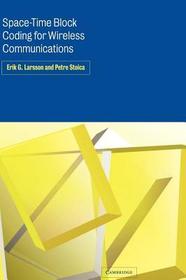
Space-Time Block Coding for Wireless Communications
- Publisher's listprice GBP 106.00
-
47 859 Ft (45 580 Ft + 5% VAT)
The price is estimated because at the time of ordering we do not know what conversion rates will apply to HUF / product currency when the book arrives. In case HUF is weaker, the price increases slightly, in case HUF is stronger, the price goes lower slightly.
- Discount 20% (cc. 9 572 Ft off)
- Discounted price 38 287 Ft (36 464 Ft + 5% VAT)
- Discount is valid until: 30 June 2026
Subcribe now and take benefit of a favourable price.
Subscribe
47 859 Ft

Availability
Estimated delivery time: In stock at the publisher, but not at Prospero's office. Delivery time approx. 3-5 weeks.
Not in stock at Prospero.
Why don't you give exact delivery time?
Delivery time is estimated on our previous experiences. We give estimations only, because we order from outside Hungary, and the delivery time mainly depends on how quickly the publisher supplies the book. Faster or slower deliveries both happen, but we do our best to supply as quickly as possible.
Product details:
- Publisher Cambridge University Press
- Date of Publication 8 May 2003
- ISBN 9780521824569
- Binding Hardback
- No. of pages302 pages
- Size 254x180x26 mm
- Weight 788 g
- Language English
- Illustrations 2 tables 71 exercises 0
Categories
Short description:
This 2003 book provides detailed coverage of a technology that is embedded in the UMTS and WCDMA mobile standards.
MoreLong description:
Space-time coding is a technique that promises greatly improved performance in wireless networks by using multiple antennas at the transmitter and receiver. Space-Time Block Coding for Wireless Communications, first published in 2003, is an introduction to the theory of this technology. The authors develop the topic using a unified framework and cover a variety of topics ranging from information theory to performance analysis and space-time coding methods for both flat and frequency-selective fading multiple-antenna channels. The authors concentrate on key principles rather than specific practical applications, and present the material in a concise and accessible manner. Their treatment reviews the fundamental aspects of multiple-input, multiple-output communication theory, and guides the reader through a number of topics at the forefront of research and development. The book includes homework exercises and is aimed at graduate students and researchers working on wireless communications, as well as practitioners in the wireless industry.
"This book will be useful for graduate students, researchers, and engineers working on wireless communications." Mathematical Reviews
Table of Contents:
1. Introduction; 2. The time-invariant linear MIMO channel; 3. MIMO information theory; 4. Error probability analysis; 5. Receive diversity; 6. Transmit diversity and space-time coding; 7. Linear STBC for flat fading channels; 8. Linear STBC for frequency-selective channels; 9. Coherent and non-coherent receivers; 10. Space-time coding for informed transmitters; 11. Space-time coding in a multiuser environment; Appendices.
More
