

- Publisher's listprice GBP 89.00
-
40 183 Ft (38 270 Ft + 5% VAT)
The price is estimated because at the time of ordering we do not know what conversion rates will apply to HUF / product currency when the book arrives. In case HUF is weaker, the price increases slightly, in case HUF is stronger, the price goes lower slightly.
- Discount 10% (cc. 4 018 Ft off)
- Discounted price 36 165 Ft (34 443 Ft + 5% VAT)
Subcribe now and take benefit of a favourable price.
Subscribe
40 183 Ft

Availability
printed on demand
Why don't you give exact delivery time?
Delivery time is estimated on our previous experiences. We give estimations only, because we order from outside Hungary, and the delivery time mainly depends on how quickly the publisher supplies the book. Faster or slower deliveries both happen, but we do our best to supply as quickly as possible.
Product details:
- Publisher OUP USA
- Date of Publication 17 June 2010
- ISBN 9780195340051
- Binding Hardback
- No. of pages256 pages
- Size 165x236x22 mm
- Weight 522 g
- Language English
- Illustrations 63 musical examples, 11 tables 0
Categories
Long description:
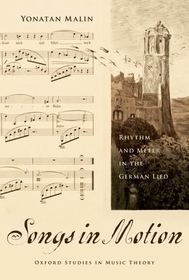
Qualities of motion and emotion in song come from poetic images, melody, harmony, and voice leading, but they also come from rhythm and metre-the flow and articulation of words and music in time. This book explores rhythm and metre in the nineteenth-century German Lied, including songs for voice and piano by Fanny Hensel née Mendelssohn, Franz Schubert, Robert Schumann, Johannes Brahms, and Hugo Wolf.
The Lied, as a genre, is characterized especially by the fusion of poetry and music. Poetic metre itself has expressive qualities, and rhythmic variations contribute further to the modes of signification. These features often carry over into songs, even as they are set in the more strictly determined periodicities of musical metre. A new method of declamatory-schema analysis is presented to illustrate common possibilities for setting trimeter, tetrameter, and pentameter lines. Degrees of rhythmic regularity and irregularity are also considered.
There has been a wealth of new work on metric theory and analysis in the past thirty years; here this research is reviewed and applied in song analysis. Topics include the nature of metric entrainment (drawing on music psychology), metric dissonance, hypermeter, and phrase rhythm.
Whereas narrative accounts of the nineteenth-century Lied typically begin with Schubert, here forms of expansion and elision in songs by Hensel provide a point of departure. Repetition links up directly with motion in songs by Schubert, including his famous "Gretchen am Spinnrade." The doubling and reverberation of vocal melody creates a form of interiorized resonance in Schumann's songs. Brahms and Wolf are typically understood as polar opposites in the later nineteenth century; here the differences are clarified along with deeper affinities. Songs by both Brahms and Wolf may be understood as musical performances of poetic readings, and in this regard they both belong to a late period of cultural history.
The book represents musicology in the best and fullest sense, as Malin makes real points regarding the historical evolution of the German Lied through his analyses of the rhythms of text, melody, and accompaniment. Moreover, Malin's analytic readings go beyond the details of how these songs work to show why they work the way they do...With Songs in Motion Malin shares both his understanding and his pleasures of these Lieder; as he aptly puts it: Thi?
Table of Contents:
Introduction
Virginians Dissent: Snakes, Hornets, and Brimstone
Negotiating Support for the War and Religious Freedom
British Failures and Plans for Success
Mobilizing Support: Did the Dissenters Fight?
After the War: A Resurgent Establishment and the End of Compulsion
What Did They Fight, and Bargain, For?
Epilogue
Notes
Bibliography
Index

