

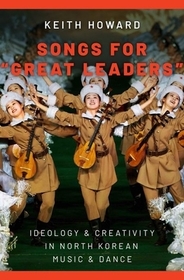
Songs for "Great Leaders"
Ideology and Creativity in North Korean Music and Dance
- Publisher's listprice GBP 77.00
-
34 765 Ft (33 110 Ft + 5% VAT)
The price is estimated because at the time of ordering we do not know what conversion rates will apply to HUF / product currency when the book arrives. In case HUF is weaker, the price increases slightly, in case HUF is stronger, the price goes lower slightly.
- Discount 10% (cc. 3 477 Ft off)
- Discounted price 31 289 Ft (29 799 Ft + 5% VAT)
Subcribe now and take benefit of a favourable price.
Subscribe
34 765 Ft

Availability
printed on demand
Why don't you give exact delivery time?
Delivery time is estimated on our previous experiences. We give estimations only, because we order from outside Hungary, and the delivery time mainly depends on how quickly the publisher supplies the book. Faster or slower deliveries both happen, but we do our best to supply as quickly as possible.
Product details:
- Publisher OUP USA
- Date of Publication 24 March 2020
- ISBN 9780190077518
- Binding Hardback
- No. of pages360 pages
- Size 155x236x33 mm
- Weight 635 g
- Language English
- Illustrations 50 illustrations 0
Categories
Short description:
The first book-length account of North Korean music and dance in any language other than Korean, Songs for "Great Leaders" pulls back the curtain for the first time on this famously reclusive and secretive regime.
MoreLong description:
Famously reclusive and secretive, North Korea can be seen as a theatre that projects itself through music and performance. The first book-length account of North Korean music and dance in any language other than Korean, Songs for "Great Leaders" pulls back the curtain on this theatre for the first time.
Renowned ethnomusicologist Keith Howard moves from the first songs written in the northern part of the divided Korean peninsula in 1946 to the performances in February 2018 by a North Korean troupe visiting South Korea for the Pyeongchang Winter Olympic Games. Through an exceptionally wide range of sources and a perspective of deep cultural competence, Howard explores old revolutionary songs and new pop songs, developments of Korean instruments, the creation of revolutionary operas, and mass spectacles, as well as dance and dance notation, and composers and compositions. The result is a nuanced and detailed account of how song, together with other music and dance production, forms the soundtrack to the theater of daily life, embedding messages that tell the official history, the exploits of leaders, and the socialist utopia yet-to-come. Based on fieldwork, interviews, and resources in private and public archives and libraries in North Korea, South Korea, China, North America and Europe, Songs for "Great Leaders" opens up the North Korean regime in a way never before attempted or possible.
An exemplary work of scholarship that is worth a read for those interested in innovative ethnomusicological approaches or any aspect of Korean music from traditional to contemporary. It is also a noteworthy contribution to the growing historical body of work on North Korea considering that Howard is well-versed in the historiography of the DPRK and as a result makes historical judgements and inferences instead of merely citing other schoars to provide context for pieces and practices of music.... It is hard to imagine something more insightful and more comprehensive than this work.
Table of Contents:
Introduction
1 Songs for the Great Leader
Songs, for the people and of the people
Songs, and song composers
Songs, assembled for the concert stage
Songs to build the state
Songs, built on the foundations of folksongs
2 Instruments of the People
Kaeryang akki: "improving" Korean instruments
Soviet and/or Chinese influence?
North Korean particularity
The chang saenap
Winds of change
The "hand wind zither"
3 Pulling at Harp Strings
Discarding the old?
Retaining the national zither, kayagum
Creating string instruments, from old to new
Discarding and creating lutes and dulcimers
Drums of persuasion
A new harp, or zither, or both?
4 Opera for the Revolution
Preface: juche ideology
Introducing revolutionary operas
"Sea of Blood"
"A True Daughter of the Party"
"The Flower Girl"
"Oh! Tell the Forest" and "The Song of Mount Kumgang"
5 Contextualizing Revolutionary Operas
Are revolutionary operas revolutionary?
Guided by the leaders
Before revolutionary opera
Beyond revolutionary opera
6 What Revolutionary Operas Do
Revolutionary operas as song operas
Song constructions
Portable songs
Operas as ideology, and opera as spectacle
7 From Spectacles to Dance
Watching the 50,000
Spectacles, calisthenics, gymnastics
Notating dances, prescribing spectacles
Chamo p'yogibop
A pan-Korean notation?
Ch'oe Sunghui and the development of dance in North Korea
North Korean dance, an overview
8 Composing the Nation
Learning to compose
Songs, as foundations
Upscaling songs ...
... Back to symphonies
Yun Isang, from South to North
9 Songs for New Leaders
Authorized pop
Pop as state telegraph
Footsteps of the general
Onward towards the "final victory"
Rolands and Yamahas
Epilogue
References
Index

