

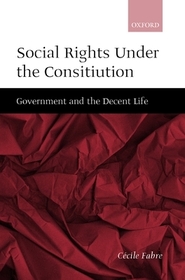
Social Rights Under the Constitution
Government and the Decent Life
- Publisher's listprice GBP 225.00
-
101 587 Ft (96 750 Ft + 5% VAT)
The price is estimated because at the time of ordering we do not know what conversion rates will apply to HUF / product currency when the book arrives. In case HUF is weaker, the price increases slightly, in case HUF is stronger, the price goes lower slightly.
- Discount 10% (cc. 10 158 Ft off)
- Discounted price 91 429 Ft (87 075 Ft + 5% VAT)
Subcribe now and take benefit of a favourable price.
Subscribe
101 587 Ft

Availability
printed on demand
Why don't you give exact delivery time?
Delivery time is estimated on our previous experiences. We give estimations only, because we order from outside Hungary, and the delivery time mainly depends on how quickly the publisher supplies the book. Faster or slower deliveries both happen, but we do our best to supply as quickly as possible.
Product details:
- Publisher OUP Oxford
- Date of Publication 2 March 2000
- ISBN 9780198296751
- Binding Hardback
- No. of pages214 pages
- Size 242x163x19 mm
- Weight 460 g
- Language English 0
Categories
Short description:
The book theoretically examines the recent and topical debates over democracy and social rights, arguing that there are four fundamental rights that should be constitutionalized; minimum income; housing; healthcare; and education. The theoretical discussion is explored within an analysis of important legal cases.
MoreLong description:
The desirability, or lack thereof, of bills of rights has been the focus of some of the most enduring political debates over the last two centuries. Unlike civil and political rights, social rights to the meeting of needs, standardly rights to adequate minimum income, education, housing, and health care are not usually given constitutional protection. This book argues that social rights should be constitutionalized and protected by the courts, and examines when such constitutionalization conflicts with democracy. It is thus located at the crossroads of two major issues of contemporary political philosophy, to wit, the issue of democracy and the issue of distributie justice. Interestingly and surprisingly enough, philosophers who engage in penetrating discussions on distributive justice do not usually reflect on the implications of their argument for democracy; they are met with equal indifference on the part of theorists of democracy. This book stems from the perception that there may be conflicts between the demands of democracy and the demands of distributive justice, both of which are crucially important, and from the resulting recognition that the question of the relationship between these two values cannot be ignored.
A stimulating and worthwhile read for anyone interested in social justice, constitutional rights or contemporary political theory. It contains challenging and thought-provoking analysis which may unsettle or, at the very least, question some common assumptions about social rights. Perhaps the greatest benefit of this book for public lawyers lies in her reliance on a rich philosophical literature of which United Kingdom public lawyers are sometimes unaware ... One of the book's merits is the seriousness with which Fabre takes her opponents and the attention she devotes to examining and sometimes refuting their arguments.
Table of Contents:
Introduction
Social rights
Negative and positive rights
Constitutional social rights
Conclusion

