

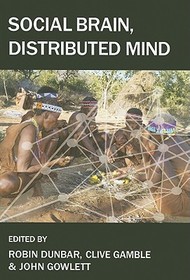
Social Brain, Distributed Mind
Series: Proceedings of the British Academy; 158;
- Publisher's listprice GBP 100.00
-
45 150 Ft (43 000 Ft + 5% VAT)
The price is estimated because at the time of ordering we do not know what conversion rates will apply to HUF / product currency when the book arrives. In case HUF is weaker, the price increases slightly, in case HUF is stronger, the price goes lower slightly.
- Discount 10% (cc. 4 515 Ft off)
- Discounted price 40 635 Ft (38 700 Ft + 5% VAT)
Subcribe now and take benefit of a favourable price.
Subscribe
45 150 Ft

Availability
Estimated delivery time: In stock at the publisher, but not at Prospero's office. Delivery time approx. 3-5 weeks.
Not in stock at Prospero.
Why don't you give exact delivery time?
Delivery time is estimated on our previous experiences. We give estimations only, because we order from outside Hungary, and the delivery time mainly depends on how quickly the publisher supplies the book. Faster or slower deliveries both happen, but we do our best to supply as quickly as possible.
Product details:
- Publisher OUP Oxford
- Date of Publication 29 April 2010
- ISBN 9780197264522
- Binding Hardback
- No. of pages548 pages
- Size 241x168x33 mm
- Weight 1130 g
- Language English 0
Categories
Short description:
This volume explores how hominin 'brains' became recognisably human 'minds', comparing perspectives from the humanities, social, and biological sciences. New ideas associated with the social brain hypothesis and the concept of the distributed mind, allow us to envisage what might have happened in this crucial phase leading up to modern humans.
MoreLong description:
To understand who we are and why we are, we need to understand both modern humans and the ancestral stages that brought us to this point. The core to that story has been the role of evolving cognition -the social brain - in mediating the changes in behaviour that we see in the archaeological record.
This volume brings together two powerful approaches - the social brain hypothesis and the concept of the distributed mind. The volume compares perspectives on these two approaches from a range of disciplines, including archaeology, psychology, philosophy, sociology and the cognitive and evolutionary sciences.
A particular focus is on the role that material culture plays as a scaffold for distributed cognition, and how almost three million years of artefact and tool uses provides the data for tracing key changes in areas such as language, technology, kinship, music, social networks and the politics of local, everyday interaction in small-world societies. A second focus is on how, during the course of hominin evolution, increasingly large spatially distributed communities created stresses that threatened social cohesion.
This volume offers the possibility of new insights into the evolution of human cognition and social lives that will further our understanding of the relationship between mind and world.
There is much of value to this volume.
Table of Contents:
Framing the Issues: Evolution of the Social Brain
The Social Brain and its Distributed Mind
Technologies of Separation and the Evolution of Social Extension
Herto Brains and Minds: Behaviour of Early Homo Sapiens from the Middle Awash, Ethiopia
The Nature of Network: Bonds of Sociality
Social Complexity and the Importance of Indirect Relationships: Social Networks in Primates
Fission-Fusion Behaviour in Chimpanzees and Hunter-Gatherers
Constraints on Social Networks
Social Networks and Community in the Viking Age
Evolving Bonds of Sociality
Deacon's Dilemma: the Problem of Pairbonding in Human Evolution
The Evolution of Altruism via Social Addiction
From Experiential-Based to Relational-Based forms of Social Organization: a Major Transition in the Evolution of Homo Sapiens
Networks and the Evolution of Socio-Material Differentiation
The Reach of the Brain: Modern Humans and Distributed Minds
When Individuals Do Not Stop at the Skin
Cliques, Coalitions, Comrades, and Colleagues: Sources of Cohesion in Groups
Evolutionary Signalling Theory and Religion: Recent Advances and Future Directions
Some Functions of Collective Forgetting
Consciousness and Culture
Testing the Past: Archaeology and the Social Brain in Past Action
Firing up the Intellect
Multi-Tasking and the Social Brain in Middle Pleistocene Africa
The Archaeology of Group Size
Fragmenting Hominins and the Presencing of Early Palaeolithic Social Worlds
Small Worlds, Material Culture and Ancient Near Eastern Social Networks
Brain, Mind and Material Culture in Evolutionary Perspective

