

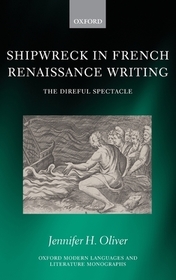
Shipwreck in French Renaissance Writing
Series: Oxford Modern Languages and Literature Monographs;
- Publisher's listprice GBP 102.50
-
46 278 Ft (44 075 Ft + 5% VAT)
The price is estimated because at the time of ordering we do not know what conversion rates will apply to HUF / product currency when the book arrives. In case HUF is weaker, the price increases slightly, in case HUF is stronger, the price goes lower slightly.
- Discount 10% (cc. 4 628 Ft off)
- Discounted price 41 651 Ft (39 668 Ft + 5% VAT)
Subcribe now and take benefit of a favourable price.
Subscribe
46 278 Ft

Availability
printed on demand
Why don't you give exact delivery time?
Delivery time is estimated on our previous experiences. We give estimations only, because we order from outside Hungary, and the delivery time mainly depends on how quickly the publisher supplies the book. Faster or slower deliveries both happen, but we do our best to supply as quickly as possible.
Product details:
- Publisher OUP Oxford
- Date of Publication 29 August 2019
- ISBN 9780198831709
- Binding Hardback
- No. of pages240 pages
- Size 241x164x20 mm
- Weight 526 g
- Language English 0
Categories
Short description:
Jennifer H. Oliver explores the extent to which depictions of the ship in sixteenth century France are freighted with political, religious, and poetic symbolism. She examines the ways in which the ship and the body are made analogous in Renaissance shipwreck writing.
MoreLong description:
In the sixteenth century, a period of proliferating transatlantic travel and exploration, and, latterly, religious civil wars in France, the ship is freighted with political and religious, as well as poetic, significance; symbolism that reaches its height when ships--both real and symbolic--are threatened with disaster. The Direful Spectacle argues that, in the French Renaissance, shipwreck functions not only as an emblem or motif within writing, but as a part, or the whole, of a narrative, in which the dynamics of spectatorship and of co-operation are of constant concern. The possibility of ethical distance from shipwreck--imagined through the Lucretian suave mari magno commonplace--is constantly undermined, not least through a sustained focus on the corporeal. This book examines the ways in which the ship and the body are made analogous in Renaissance shipwreck writing; bodies are described and allegorized in nautical terms, and, conversely, ships themselves become animalized and humanized. Secondly, many texts anticipate that the description of shipwreck will have an affect not only on its victims, but on those too of spectators, listeners, and readers. This insistence on the physicality of shipwreck is also reflected in the dynamic of bricolage that informs the production of shipwreck texts in the Renaissance. The dramatic potential of both the disaster and the process of rebuilding is exploited throughout the century, culminating in a shipwreck tragedy. By the late Renaissance, shipwreck is not only the end, but often forms the beginning of a story.
MoreTable of Contents:
Introduction
'Le naufrage de ce mortel monde': Shipwreck and the Nef
'? deux doigtz prés de la mort': From shipwreck to storm scene (and back again)
'Cet universel naufrage du monde': Shipwreck in a time of civil war
'Shipwreckful' afterlives: 'Naufrage' and Histoire
Conclusion
Bibliography
Index

