

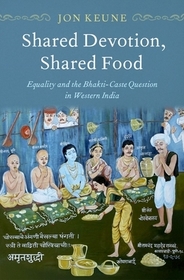
Shared Devotion, Shared Food
Equality and the Bhakti-Caste Question in Western India
- Publisher's listprice GBP 98.00
-
44 247 Ft (42 140 Ft + 5% VAT)
The price is estimated because at the time of ordering we do not know what conversion rates will apply to HUF / product currency when the book arrives. In case HUF is weaker, the price increases slightly, in case HUF is stronger, the price goes lower slightly.
- Discount 10% (cc. 4 425 Ft off)
- Discounted price 39 822 Ft (37 926 Ft + 5% VAT)
Subcribe now and take benefit of a favourable price.
Subscribe
44 247 Ft

Availability
printed on demand
Why don't you give exact delivery time?
Delivery time is estimated on our previous experiences. We give estimations only, because we order from outside Hungary, and the delivery time mainly depends on how quickly the publisher supplies the book. Faster or slower deliveries both happen, but we do our best to supply as quickly as possible.
Product details:
- Publisher OUP USA
- Date of Publication 30 September 2021
- ISBN 9780197574836
- Binding Hardback
- No. of pages328 pages
- Size 160x241x27 mm
- Weight 680 g
- Language English 142
Categories
Short description:
Shared Devotion, Shared Food explores how people in western India wrestled for centuries with two competing values: a theological vision that God welcomes all people, and the social hierarchy of the caste system. Jon Keune examines the ways in which food and stories about food were important sites where this debate played out, particularly when people of high and low social status ate together. By studying Marathi manuscripts, nineteenth-century publications, plays, and films, Shared Devotion, Shared Food reveals how the question of caste, inclusivity, and equality was formulated in different ways over the course of three centuries, and it explores why social equality remains so elusive in practice.
MoreLong description:
When Hindu devotional or bhakti traditions welcomed marginalized people-women, low castes, and Dalits-were they promoting social equality? In this book, Jon Keune deftly examines the root of this deceptively simple question. The modern formulation of the bhakti-caste question is what Dalit leader B. R. Ambedkar had in mind when he concluded that the saints promoted spiritual equality but did not transform society. While taking Ambedkar's judgment seriously, Jon Keune argues that, when viewed in the context of intellectual history and social practice, the bhakti-caste question is more complex.
Shared Devotion, Shared Food explores how people in western India wrestled for centuries with two competing values: a theological vision that God welcomes all people, and the social hierarchy of the caste system. Keune examines the ways in which food and stories about food were important sites where this debate played out, particularly when people of high and low social status ate together. By studying Marathi manuscripts, nineteenth-century publications, plays, and films, Shared Devotion, Shared Food reveals how the question of caste, inclusivity, and equality was formulated in different ways over the course of three centuries, and it explores why social equality remains so elusive in practice.
Through a detailed study of commensality practices, Keune offers a brilliant historical analysis of the relationship between bhakti traditions and the reality of caste hierarchies.
Table of Contents:
CONTENTS
Introduction
Part One
1. Religion and Social Change: Narratives of Outrage and Disappointment
2. Sightings of bhakti and its social impact
3. Bhakti and equality in Marathi print, 1854-1950
Part Two
4. The Complications of Eating Together
5. Memories of transgressive commensality
6. Restaging Transgressive Commensality
7. Bhakti in the Shadow of Ambedkar
Conclusion
Bibliography

