

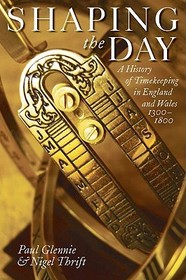
Shaping the Day
A History of Timekeeping in England and Wales 1300-1800
- Publisher's listprice GBP 110.00
-
49 665 Ft (47 300 Ft + 5% VAT)
The price is estimated because at the time of ordering we do not know what conversion rates will apply to HUF / product currency when the book arrives. In case HUF is weaker, the price increases slightly, in case HUF is stronger, the price goes lower slightly.
- Discount 10% (cc. 4 967 Ft off)
- Discounted price 44 699 Ft (42 570 Ft + 5% VAT)
Subcribe now and take benefit of a favourable price.
Subscribe
49 665 Ft

Availability
printed on demand
Why don't you give exact delivery time?
Delivery time is estimated on our previous experiences. We give estimations only, because we order from outside Hungary, and the delivery time mainly depends on how quickly the publisher supplies the book. Faster or slower deliveries both happen, but we do our best to supply as quickly as possible.
Product details:
- Publisher OUP Oxford
- Date of Publication 12 February 2009
- ISBN 9780199278206
- Binding Hardback
- No. of pages480 pages
- Size 240x163x28 mm
- Weight 968 g
- Language English
- Illustrations 8pp plates, 53 in-text illustrations 0
Categories
Short description:
Overturning many common perceptions of the past - for example, that clock time and the industrial revolution were intimately related - this unique historical study will engage all readers interested in how 'telling the time' has come to dominate our way of life.
MoreLong description:
Timekeeping is an essential activity in the modern world, and we take it for granted that our lives are shaped by the hours of the day. Yet what seems so ordinary today is actually the extraordinary outcome of centuries of technical innovation and circulation of ideas about time.
Shaping the Day is a pathbreaking study of the practice of timekeeping in England and Wales between 1300 and 1800. Drawing on many unique historical sources, ranging from personal diaries to housekeeping manuals, Paul Glennie and Nigel Thrift illustrate how a particular kind of common sense about time came into being, and how it developed during this period.
Many remarkable figures make their appearance, ranging from the well-known, such as Edmund Halley, Samuel Pepys, and John Harrison, who solved the problem of longitude, to less familiar characters, including sailors, gamblers, and burglars.
Overturning many common perceptions of the past-for example, that clock time and the industrial revolution were intimately related-this unique historical study will engage all readers interested in how 'telling the time' has come to dominate our way of life.
There is a great deal of interest in this book, and many thought-provoking questions posed ... a provocative new look at timekeeping.
Table of Contents:
List of Figures
List of Plates
List of Tables
Introduction: The Measured Heart
Clocks, Clock-times, and Social Change
"Not Everyone Occupies the Same Now": Reconceptualising Clock Times
Clock-times in Medieval and Early Modern Bristol
Temporal Infrasturcture: The Provision of Clock-Time in England
Clock-times in Everyday Lives
Precision in Everyday Lives
"Posted Within Shot of the Grave": Temporal Practices Among Seafarers
The Pursuit of Precision
"Clocks from Nowhere"? John Harrison in Context
Some Concluding Remarks
Bibliography
Index

