

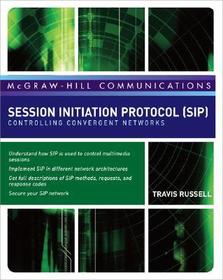
Session Initiation Protocol (SIP): Controlling Convergent Networks
Series: NETWORKING & COMM - OMG;
- Publisher's listprice GBP 87.99
-
39 727 Ft (37 835 Ft + 5% VAT)
The price is estimated because at the time of ordering we do not know what conversion rates will apply to HUF / product currency when the book arrives. In case HUF is weaker, the price increases slightly, in case HUF is stronger, the price goes lower slightly.
- Discount 10% (cc. 3 973 Ft off)
- Discounted price 35 754 Ft (34 052 Ft + 5% VAT)
Subcribe now and take benefit of a favourable price.
Subscribe
39 727 Ft

Availability
Estimated delivery time: In stock at the publisher, but not at Prospero's office. Delivery time approx. 3-5 weeks.
Not in stock at Prospero.
Why don't you give exact delivery time?
Delivery time is estimated on our previous experiences. We give estimations only, because we order from outside Hungary, and the delivery time mainly depends on how quickly the publisher supplies the book. Faster or slower deliveries both happen, but we do our best to supply as quickly as possible.
Product details:
- Publisher McGraw Hill
- Date of Publication 16 August 2008
- ISBN 9780071488525
- Binding Hardback
- No. of pages264 pages
- Size 241x193x22 mm
- Weight 711 g
- Language English 0
Categories
Long description:
Publisher's Note: Products purchased from Third Party sellers are not guaranteed by the publisher for quality, authenticity, or access to any online entitlements included with the product.
Build a next-generation telecommunications infrastructure
Consolidate divergent networks into one seamless, high-performance communications landscape using cutting-edge SIP technology, tools, and techniques. Session Initiation Protocol (SIP): Controlling Convergent Networks explains how to deliver Internet phone calls, IMs, video streams, and teleconferences across legacy, wireless, and wireline networks. Learn how to manage SIP sessions, build layers and proxies, interpret control codes, set up gateways, and comply with IETF and 3GPP standards. You'll also get details on using the latest methods, maximizing QoS, and implementing security measures.
- Initiate, modify, and terminate IETF-compliant SIP sessions
- Construct SIP messages, requests, proxies, functions, and layers
- Interconnect WiFi, WiMax, VoIP, and wireline networks
- Incorporate TDM and SS7 systems using media and signaling gateways
- Determine user locations with REGISTER and presence techniques
- Augment functionality using RFCs and packet cable extensions
- Prevent hijacking, tampering, DoS, DDoS, and BOTS attacks
- Implement reliable authentication, encryption, and intrusion detection policies
Publisher's Note: Products purchased from Third Party sellers are not guaranteed by the publisher for quality, authenticity, or access to any online entitlements included with the product.
Build a next-generation telecommunications infrastructure
Consolidate divergent networks into one seamless, high-performance communications landscape using cutting-edge SIP technology, tools, and techniques. Session Initiation Protocol (SIP): Controlling Convergent Networks explains how to deliver Internet phone calls, IMs, video streams, and teleconferences across legacy, wireless, and wireline networks. Learn how to manage SIP sessions, build layers and proxies, interpret control codes, set up gateways, and comply with IETF and 3GPP standards. You'll also get details on using the latest methods, maximizing QoS, and implementing security measures.
- Initiate, modify, and terminate IETF-compliant SIP sessions
- Construct SIP messages, requests, proxies, functions, and layers
- Interconnect WiFi, WiMax, VoIP, and wireline networks
- Incorporate TDM and SS7 systems using media and signaling gateways
- Determine user locations with REGISTER and presence techniques
- Augment functionality using RFCs and packet cable extensions
- Prevent hijacking, tampering, DoS, DDoS, and BOTS attacks
- Implement reliable authentication, encryption, and intrusion detection policies
Table of Contents:
Chapter 1 - Architecture of a SIP Network
Chapter 2 - Structure of the SIP Protocol
Chapter 3 - SIP Status Codes
Chapter 4 – SIP Registration Procedures in a SIP Network
Chapter 5 – Establishing a Session in SIP
Chapter 6 – Extending SIP to Support New Functions
Chapter 7 – Security in a SIP Network
Appendix A - SIP-Related RFCs
Appendix B - Methods and Parameters
Appendix C - Methods and Parameters from a Proxy Perspective
Bibliography
Index

