

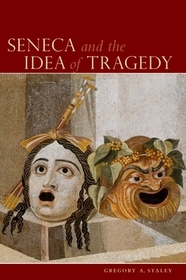
Seneca and the Idea of Tragedy
- Publisher's listprice GBP 105.00
-
47 407 Ft (45 150 Ft + 5% VAT)
The price is estimated because at the time of ordering we do not know what conversion rates will apply to HUF / product currency when the book arrives. In case HUF is weaker, the price increases slightly, in case HUF is stronger, the price goes lower slightly.
- Discount 10% (cc. 4 740 Ft off)
- Discounted price 42 667 Ft (40 635 Ft + 5% VAT)
Subcribe now and take benefit of a favourable price.
Subscribe
47 407 Ft

Availability
printed on demand
Why don't you give exact delivery time?
Delivery time is estimated on our previous experiences. We give estimations only, because we order from outside Hungary, and the delivery time mainly depends on how quickly the publisher supplies the book. Faster or slower deliveries both happen, but we do our best to supply as quickly as possible.
Product details:
- Publisher OUP USA
- Date of Publication 14 January 2010
- Number of Volumes Hardback
- ISBN 9780195387438
- Binding Hardback
- No. of pages200 pages
- Size 234x156x12 mm
- Weight 458 g
- Language English 0
Categories
Short description:
The question of why Seneca wrote tragedy has been debated at least since the 13th century. Since Seneca was a Stoic, critics have assumed that he must have written with the standard Stoic theory of literature as education in philosophy in mind. Seneca and the Idea of Tragedy argues instead that Seneca was influenced by Aristotle's famous defense of tragedy against Plato's critique. When Renaissance scholars applied Aristotle's theory of tragedy to Seneca and found him to be a model tragedian, they were taking the correct approach, one which has since been discounted since Aristotle's Poetics was presumed to have been unknown during Seneca's lifetime. Staley shows that Aristotle's ideas about poetry influenced the Stoics through channels other than the Poetics and that Aristotle's idea of tragedy was adopted by Seneca in a Stoic guise.
MoreLong description:
As both a literary genre and a view of life, tragedy has from the very beginning spurred a dialogue between poetry and philosophy. Plato famously banned tragedians from his ideal community because he believed that their representations of vicious behavior could deform minds. Aristotle set out to answer Plato's objections, arguing that fiction offers a faithful image of the truth and that it promotes emotional health through the mechanism of catharsis. Aristotle's definition of tragedy actually had its greatest impact not on Greek tragedy itself but on later Latin literature, beginning with the tragedies of the Roman poet and Stoic philosopher Seneca (4 BC - AD 65). Scholarship over the last fifty years, however, has increasingly sought to identify in Seneca's prose writings a Platonic poetics which is antagonistic toward tragedy and which might therefore explain why Seneca's plays seem so often to present the failure of Stoicism. As Gregory Staley argues in this book, when Senecan tragedy fails to stage virtue we should see in this not the failure of Stoicism but a Stoic conception of tragedy as the right vehicle for imaging Seneca's familiar world of madmen and fools. Senecan tragedy enacts Aristotle's conception of the genre as a vivid image of the truth and treats tragedy as a natural venue in which to explore the human soul. Staley's reading of Seneca's plays draws on current scholarship about Stoicism as well as on the writings of Renaissance authors like Sir Philip Sidney, who borrowed from Seneca the word "idea" to designate what we would now label as a "theory" of tragedy. Seneca and the Idea of Tragedy will appeal broadly to students and scholars of classics, ancient philosophy, and English literature.
Impressive and stimulating
Table of Contents:
Preface
Acknowledgements
Abbreviations
Introduction: The Idea of Tragedy
Theorizing Tragedy
The Very Ends of Poesy
A Just and Lively Image
The Soul of Tragedy
Reading Monsters
Conclusion: Stoic Tragedy
Notes
Bibliography
Index

