

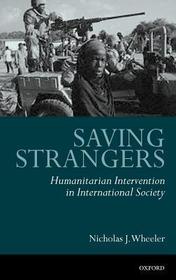
Saving Strangers
Humanitarian Intervention in International Society
- Publisher's listprice GBP 170.00
-
76 755 Ft (73 100 Ft + 5% VAT)
The price is estimated because at the time of ordering we do not know what conversion rates will apply to HUF / product currency when the book arrives. In case HUF is weaker, the price increases slightly, in case HUF is stronger, the price goes lower slightly.
- Discount 10% (cc. 7 676 Ft off)
- Discounted price 69 080 Ft (65 790 Ft + 5% VAT)
Subcribe now and take benefit of a favourable price.
Subscribe
76 755 Ft

Availability
printed on demand
Why don't you give exact delivery time?
Delivery time is estimated on our previous experiences. We give estimations only, because we order from outside Hungary, and the delivery time mainly depends on how quickly the publisher supplies the book. Faster or slower deliveries both happen, but we do our best to supply as quickly as possible.
Product details:
- Publisher OUP Oxford
- Date of Publication 7 September 2000
- ISBN 9780198296218
- Binding Hardback
- No. of pages352 pages
- Size 241x163x23 mm
- Weight 650 g
- Language English 0
Categories
Short description:
Saving Strangers examines the extent to which humanitarian intervention has become a legitimate practice in international society. It maps the changing legitimacy of humanitarian intervention by comparing the international response to cases of humanitarian intervention in the cold war and post-cold war periods. Crucially, the book examines how far international society has recognised humanitarian intervention as a legitimate exception to the rules of sovereignty and non-intervention and non-use of force. While there are studies of each case of intervention - in East Pakistan, Cambodia, Uganda, Iraq, Somalia, Rwanda, Bosnia and Kosovo - there is no single work that examines them comprehensively in a comparative framework.
MoreLong description:
The extent to which humanitarian intervention has become a legitimate practice in post-cold war international society is the subject of this book. It maps the changing legitimacy of humanitarian intervention by comparing the international response to cases of humanitarian intervention in the cold war and post-cold war periods. Crucially, the book examines how far international society has recognised humanitarian intervention as a legitimate exception to the rules of sovereignty and non-intervention and non-use of force. While there are studies of each case of intervention - in East Pakistan, Cambodia, Uganda, Iraq, Somalia, Rwanda, Bosnia and Kosovo - there is no single work that examines them comprehensively in a comparative framework. Each chapter tells a story of intervention that weaves together a study of motives, justifications and outcomes. The legitimacy of humanitarian intervention is contested by the 'pluralist' and 'solidarist' wings of the English school, and the book charts the stamp of these conceptions on state practice. Solidarism lacks a full-blown theory of humanitarian intervention and the book supplies one. A key focus is to examine how is humanitarian intervention legitimate in present diplomatic dialogues. In exploring how far there has been a change of norm in the society of states in the 1990s, the book defends the broad based constructivist claim that state actions will be constrained if they cannot be legitimated, and that new norms enable new practices but do not determine these. The book concludes by considering how far contemporary practices of humanitarian intervention support a new solidarism, and how far this resolves the traditional conflict between order and justice in international society.
Saving Strangers is a lucid, well-argued work that explicitly links its discussion of the circumstances under which intervention might be legitimate to its account of the nature of international society.
Table of Contents:
Introduction
Humanitarian Intervention and International Society
India as Rescuer? Order versus Justice in the Bangladesh War of 1971
Vietnam's Intervention in Cambodia: The triumph of realism over common humanity?
Good or bad precedent? Tanzania's Intervention in Uganda
A Solidarist Movement in International Society? The case of Safe Havens and 'No-Fly' Zones in Iraq
From Famine Relief to 'Humanitarian War'; the US and UN Intervention in Somalia
Global Bystanders to Genocide: International Society and the Rwandan Genocide of 1994
The Limit of Humanitarian Intervention from the Air: the cases of Bosnia and Kosovo
A New Solidarity? Humanitarian Intervention and the Future of International Society

