

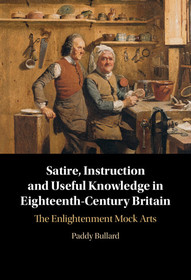
Satire, Instruction and Useful Knowledge in Eighteenth-Century Britain
The Enlightenment Mock Arts
- Publisher's listprice GBP 90.00
-
40 635 Ft (38 700 Ft + 5% VAT)
The price is estimated because at the time of ordering we do not know what conversion rates will apply to HUF / product currency when the book arrives. In case HUF is weaker, the price increases slightly, in case HUF is stronger, the price goes lower slightly.
- Discount 20% (cc. 8 127 Ft off)
- Discounted price 32 508 Ft (30 960 Ft + 5% VAT)
- Discount is valid until: 30 June 2026
Subcribe now and take benefit of a favourable price.
Subscribe
40 635 Ft

Availability
Estimated delivery time: In stock at the publisher, but not at Prospero's office. Delivery time approx. 3-5 weeks.
Not in stock at Prospero.
Why don't you give exact delivery time?
Delivery time is estimated on our previous experiences. We give estimations only, because we order from outside Hungary, and the delivery time mainly depends on how quickly the publisher supplies the book. Faster or slower deliveries both happen, but we do our best to supply as quickly as possible.
Product details:
- Publisher Cambridge University Press
- Date of Publication 8 May 2025
- ISBN 9781009460521
- Binding Hardback
- No. of pages278 pages
- Size 235x160x20 mm
- Weight 550 g
- Language English 712
Categories
Short description:
A nuanced history showing how British writers came to terms with the early Industrial Revolution through satire on instructional literature.
MoreLong description:
Long before the Industrial Revolution was deplored by the Romantics or documented by the Victorians, eighteenth-century British writers were thinking deeply about the function of literature in an age of invention. They understood the significance of 'how-to' knowledge and mechanical expertise to their contemporaries. Their own framing of this knowledge, however, was invariably satirical, critical, and oblique. While others compiled encyclopaedias and manuals, they wrote 'mock arts'. This satirical sub-genre shaped (among other works) Swift's Gulliver's Travels, Sterne's Tristram Shandy, and Edgeworth's Belinda. Eighteenth-century satirists and poets submitted to a general paradox: the nature of human skilfulness obliged them to write in an indirect and unpractical way about the practical world. As a result, their explorations of mechanical expertise eschewed useable descriptions of the mechanical trades. They wrote instead a long and peculiar line of books that took apart the very idea of an instructional literature: the Enlightenment Mock Arts.
'Bullard has written what will become the how-to of how-to satire in the long eighteenth century. This is a thrilling and instructive read which invites us to think differently about the texts presented here through the lens of the mock arts.' Helen Williams, Associate Professor of English Literature, Northumbria University
Table of Contents:
1. Introduction: enlightenment mock arts and industrial enlightenment; 2. Daedalus and Proteus: satire and useful knowledge in seventeenth-century England; 3. The Scriblerian mock arts: eighteenth-century satires of didacticism; 4. Anthropologies of the mechanical arts: Robinson Crusoe and Gulliver's travels; 5. Ingenuity, industry, experience: eighteenth-century georgic; 6. Manuals of mock arts: the art of ingeniously tormenting and Tristram Shandy; 7. The art of teaching to invent: Maria Edgeworth and the lunar society.
More
