

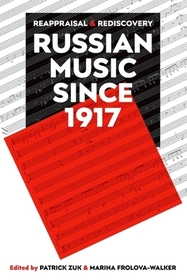
Russian Music since 1917
Reappraisal and Rediscovery
Series: Proceedings of the British Academy; 209;
- Publisher's listprice GBP 85.00
-
38 377 Ft (36 550 Ft + 5% VAT)
The price is estimated because at the time of ordering we do not know what conversion rates will apply to HUF / product currency when the book arrives. In case HUF is weaker, the price increases slightly, in case HUF is stronger, the price goes lower slightly.
- Discount 10% (cc. 3 838 Ft off)
- Discounted price 34 540 Ft (32 895 Ft + 5% VAT)
Subcribe now and take benefit of a favourable price.
Subscribe
38 377 Ft

Availability
Estimated delivery time: In stock at the publisher, but not at Prospero's office. Delivery time approx. 3-5 weeks.
Not in stock at Prospero.
Why don't you give exact delivery time?
Delivery time is estimated on our previous experiences. We give estimations only, because we order from outside Hungary, and the delivery time mainly depends on how quickly the publisher supplies the book. Faster or slower deliveries both happen, but we do our best to supply as quickly as possible.
Product details:
- Publisher OUP Oxford
- Date of Publication 28 September 2017
- ISBN 9780197266151
- Binding Hardback
- No. of pages450 pages
- Size 242x172x34 mm
- Weight 878 g
- Language English 0
Categories
Short description:
These essays bring into clearer focus the transformation in the study of Russian music that has occurred since glasnost. Concentrating on Russian music since 1917, the volume shows how censorship in the USSR hindered developments in scholarship, and explains some difficulties experienced by musicians and scholars in the post-soviet era.
MoreLong description:
This ground-breaking collection of essays, which arises from a unique collaboration between leading scholars based on either side of the former Iron Curtain, is the first attempt to appraise the current state of research on the development of Russian art music since the 1917 Revolution. Part I provides a comprehensive critical overview of recent research both in Russia itself and outside it, outlining the principal changes in approach and emphasis. The remaining essays engage with topics of key importance, including: the envisionings of music's place in Soviet and post-Soviet cultural life; the effects of state controls on musical creativity and performance; musical institutions; the Russian musical diaspora; and the transition to the post-Soviet period.
The contributions vividly illustrate the transformation of scholarship in the field since glasnost. In the USSR, scholarship had been seriously hindered by censorship, while in the West, Soviet music and musical life tended to be assessed from entrenched aesthetic and ideological standpoints engendered by the Cold War. The dramatically changed climate of the post-Soviet period has made possible a more objective and informed discussion of many issues, and has led scholars to question the validity of 'top-down' models of the interaction between musicians and the state that had previously been predominant.
The book will be not only be a valuable resource for university courses on Russian music at undergraduate and postgraduate level, but essential reading for all those interested in Soviet and post-Soviet culture.
To be presented with eighteen studies on Russian and Soviet music that avoid dramatic or romanticised language brings great hope for the future of the field. Frolova-Walker and Zuk are to be congratulated on the quality, detail, and accessibility of their volume, which marks a milestone in Russian and Soviet music studies, an area for which appraisal and reappraisal has been long overdue.
Table of Contents:
Introduction
Part I: Russian Music History and Historiography Today
Russian Musicological Scholarship of the Last Two Decades: Achievements and Lacunae
Soviet Music Studies outside Russia: glasnost and after
The Adventures of Soviet Music in the West: Historical Highlights
Soviet Music in Post-Soviet Musicology: First Twenty Years and Beyond
Part II: Reappraising the Soviet Past
The Phenomenon of 'Translation' in Russian Musical Culture of the 1920s and Early 1930s: The Quest for a Soviet Musical Identity
From Enlightened to Sublime: Musical Life under Stalin, 1930-1948
The Stalinist Opera Project
Composers in the GULAG: A Preliminary Survey
Part III: Soviet and post-Soviet musicology
'Foreign' Versus 'Russian' in Soviet and Post-Soviet Musicology and Music Education
Glinka in Soviet and Post-Soviet Historiography: Myths, Realities, and Ideologies
Part IV: The Newest Shostakovich
Portrait of the Artist as a Young Man: The Shostakovich-Bogdanov-Berezovsky Correspondence
Shostakovich's 'Lenin' Project: The 'Pre-Twelfth' Symphony - Reality or Myth?
Part V: Russian Music Abroad
Is There a "Russia Abroad" in Music?
Defining Diaspora through Culture: Russian --migr-- Composers in a Globalising World
Part VI: 1991 and after
Musical Uproar in Moscow (II)
The Idea of the 1920s in Russian Music Today
Paradigms of Contemporary Music in Twenty-First-Century Russia

