

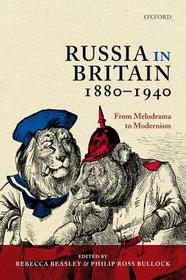
Russia in Britain, 1880-1940
From Melodrama to Modernism
- Publisher's listprice GBP 120.00
-
57 330 Ft (54 600 Ft + 5% VAT)
The price is estimated because at the time of ordering we do not know what conversion rates will apply to HUF / product currency when the book arrives. In case HUF is weaker, the price increases slightly, in case HUF is stronger, the price goes lower slightly.
- Discount 10% (cc. 5 733 Ft off)
- Discounted price 51 597 Ft (49 140 Ft + 5% VAT)
Subcribe now and take benefit of a favourable price.
Subscribe
57 330 Ft

Availability
printed on demand
Why don't you give exact delivery time?
Delivery time is estimated on our previous experiences. We give estimations only, because we order from outside Hungary, and the delivery time mainly depends on how quickly the publisher supplies the book. Faster or slower deliveries both happen, but we do our best to supply as quickly as possible.
Product details:
- Publisher OUP Oxford
- Date of Publication 26 September 2013
- ISBN 9780199660865
- Binding Hardback
- No. of pages326 pages
- Size 236x170x26 mm
- Weight 656 g
- Language English
- Illustrations 7 black-and-white halftones 0
Categories
Short description:
Russia in Britain explores the extent of British fascination with Russian and Soviet culture from the 1880s up to the Soviet Union's entry into the Second World War.
MoreLong description:
Russia in Britain offers the first comprehensive account of the breadth and depth of the British fascination with Russian and Soviet culture, tracing its transformative effect on British intellectual life from the 1880s, the decade which saw the first sustained interest in Russian literature, to 1940, the eve of the Soviet Union's entry into the Second World War. By focusing on the role played by institutions, disciplines and groups, libraries, periodicals, government agencies, concert halls, publishing houses, theatres, and film societies, this collection marks an important departure from standard literary critical narratives, which have tended to highlight the role of a small number of individuals, notably Sergei Diaghilev, Constance Garnett, Theodore Komisarjevsky, Katherine Mansfield, George Bernard Shaw and Virginia Woolf. Drawing on recent research and newly available archives, Russia in Britain shifts attention from individual figures to the networks within which they operated, and uncovers the variety of forces that enabled and structured the British engagement with Russian culture. The resulting narrative maps an intricate pattern of interdisciplinary relations and provides the foundational research for a new understanding of Anglo-Russian/Soviet interaction. In this, it makes a major contribution to the current debates about transnationalism, cosmopolitanism and 'global modernisms' that are reshaping our knowledge of nineteenth- and early twentieth-century British culture.
MoreTable of Contents:
Introduction
"For God, for Tsar, and for Fatherland!" Russians on the British Stage from Napoleon to the Great War
Oscar Wilde's Vera; or The Nihilists
Britain and the International Tolstoyan Movement
The Free Russian Library in London, 1898-1917
'Avert Your Eyes and Hold Your Noses': Non-Chekhovian Russian and Soviet Drama on the British Stage, 1900-1940
Tsar's Hall: Russian Music in London, 1895-1926
Le Sacre du printemps in London: The Politics of Embodied Freedom in Early Modern Dance and Suffragette Protest
Russian Aesthetics in Britain: Kandinsky, Sadleir, and Rhythm'
Reading Russian: Russian Studies and the Literary Canon
The Translation of Soviet Literature: John Rodker and PresLit
Russia and the British Intellectuals: The Significance of the Stalin-Wells Talk
British Film Culture and Soviet Cinema
Soviet Films and British intelligence in the 1930s: The Case of Kino Films and MI5
Afterword: A Time and a Place for Everything: On Russia, Britain, and Being Modern

