

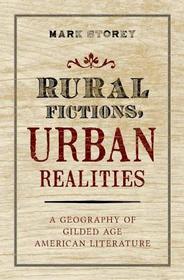
Rural Fictions, Urban Realities
A Geography of Gilded Age American Literature
- Publisher's listprice GBP 102.50
-
46 278 Ft (44 075 Ft + 5% VAT)
The price is estimated because at the time of ordering we do not know what conversion rates will apply to HUF / product currency when the book arrives. In case HUF is weaker, the price increases slightly, in case HUF is stronger, the price goes lower slightly.
- Discount 10% (cc. 4 628 Ft off)
- Discounted price 41 651 Ft (39 668 Ft + 5% VAT)
Subcribe now and take benefit of a favourable price.
Subscribe
46 278 Ft

Availability
printed on demand
Why don't you give exact delivery time?
Delivery time is estimated on our previous experiences. We give estimations only, because we order from outside Hungary, and the delivery time mainly depends on how quickly the publisher supplies the book. Faster or slower deliveries both happen, but we do our best to supply as quickly as possible.
Product details:
- Publisher OUP USA
- Date of Publication 7 February 2013
- ISBN 9780199893188
- Binding Hardback
- No. of pages208 pages
- Size 160x239x27 mm
- Weight 530 g
- Language English 0
Categories
Short description:
This study of late nineteenth-century American literature uses the period's rural fiction to reveal the increasingly intricate and sometimes problematic connections between urban and rural life.
MoreLong description:
This study of late nineteenth-century American literature begins with a simple question: how did the rise of an urban society affect the ways in which the nation's writers represented the countryside? In offering an answer, Rural Fictions, Urban Realities remaps our understanding of American literature by examining the period through its 'rural fictions'. From the coasts of Maine to the ranches of Wyoming, and from the farms of the Midwest to the small towns of the South, tales of rural life reveal the profound and sometimes problematic connections between rural America and its growing urban centers between the 1870s and the 1900s. Moreover, those connections are illuminated by showing how the representation of vital, contested, and sometimes controversial aspects of everyday life--train journeys, travelling circuses, country doctors, and lynch mobs--offer a distinct way of understanding the era's deeper social transformations. In keeping with this unique approach to the period's literature, this book ranges across a number of works by writers who have largely dropped out of scholarly discussion (Edward Eggleston, Alice Brown, Joseph Kirkland, Mary Noailles Murfree, and Booth Tarkington, to name a few) whilst also reexamining works by more well-known figures (Sarah Orne Jewett, Owen Wister, Charles Chesnutt, William Dean Howells, and Hamlin Garland, amongst others). Rural Fictions, Urban Realities proposes a new literary geography of Gilded Age America, and in the process contributes to our understanding of how we represent and register the cultural complexities of modernization.
The strength of Rural Realities, Urban Fictions lies in the helpful collation of what are arguably little-known and non-canonical texts. ... The sections of close reading of primary texts are concise, convincing, and clearly structured.
Table of Contents:
Introduction
Rural Fictions, Urban Realities
Chapter One
Lines of time, sight and capital: Train Journeys
Chapter Two
Commerce and Carnival at the Canvas City: Travelling Circuses
Chapter Three
The Place of Medical Knowledge: Country Doctors
Chapter Four
A Government of Men and Not of Laws: Lynch Mobs
Chapter Five
Geographies of the Future: Utopias
Conclusion
Notes

