

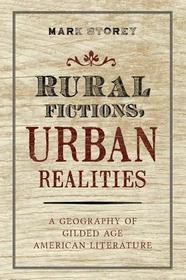
Rural Fictions, Urban Realities
A Geography of Gilded Age American Literature
- Publisher's listprice GBP 28.99
-
13 088 Ft (12 465 Ft + 5% VAT)
The price is estimated because at the time of ordering we do not know what conversion rates will apply to HUF / product currency when the book arrives. In case HUF is weaker, the price increases slightly, in case HUF is stronger, the price goes lower slightly.
- Discount 10% (cc. 1 309 Ft off)
- Discounted price 11 779 Ft (11 219 Ft + 5% VAT)
Subcribe now and take benefit of a favourable price.
Subscribe
13 088 Ft

Availability
printed on demand
Why don't you give exact delivery time?
Delivery time is estimated on our previous experiences. We give estimations only, because we order from outside Hungary, and the delivery time mainly depends on how quickly the publisher supplies the book. Faster or slower deliveries both happen, but we do our best to supply as quickly as possible.
Product details:
- Publisher OUP USA
- Date of Publication 7 January 2016
- ISBN 9780190272425
- Binding Paperback
- No. of pages210 pages
- Size 156x234x12 mm
- Weight 331 g
- Language English 0
Categories
Short description:
Rural Fictions, Urban Realities examines late nineteenth-century American literature to reveal the increasingly intricate and sometimes problematic connections between urban and rural life.
MoreLong description:
The diminishment of rural life at the hands of urbanization, for many, defines the years between the end of the Civil War and the dawn of the twentieth century in the U.S. Traditional literary histories find this transformation clearly demarcated between rural tales-stories set in the countryside, marked by attention to regional dialect and close-knit communities-and grittier novels and short stories that reflected the harsh realities of America's growing cities. Challenging this conventional division, Mark Storey proffers a capacious, trans-regional version of rural fiction that contains and coexists with urban-industrial modernity.
To remap literary representations of the rural, Storey pinpoints four key aspects of everyday life that recur with surprising frequency in late nineteenth-century fiction: train journeys, travelling circuses, country doctors, and lynch mobs. Fiction by figures such as Hamlin Garland, Booth Tarkington, and William Dean Howells use railroads and roving carnivals to signify the deeper incursions of urban capitalism into the American countryside. A similar, somewhat disruptive migration of the urban into the rural occurs with the arrival of modern medicine, as viewed in depictions of the country doctor in novels like Sarah Orne Jewett's A Country Doctor and Harold Frederic's The Damnation of Theron Ware. This discussion gives way to a far darker interaction between the urban and the rural, with the intricate relationship of vigilante justice to an emerging modernity used to frame readings of rural lynchings in works by writers like Bret Harte, Charles Chesnutt, Paul Laurence Dunbar, and Owen Wister. The four arenas-transport, entertainment, medicine, and the law-used to organize the study come together in a coda devoted to utopian fiction, which demonstrates one of the more imaginative methods used to express the social and literary anxieties around the changing nature of urban and rural space at the end of the nineteenth century.
Mining a rich variety of long neglected novels and short stories, Rural Fictions, Urban Realities provides a new literary geography of Gilded Age America, and in the process, contributes to our understanding of how we represent and register the cultural complexities of modernization.
Table of Contents:
Introduction
Rural Fictions, Urban Realities
Chapter One
Lines of time, sight and capital: Train Journeys
Chapter Two
Commerce and Carnival at the Canvas City: Travelling Circuses
Chapter Three
The Place of Medical Knowledge: Country Doctors
Chapter Four
A Government of Men and Not of Laws: Lynch Mobs
Chapter Five
Geographies of the Future: Utopias
Conclusion
Notes

