

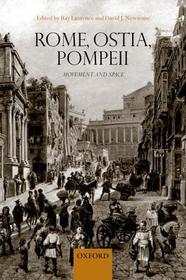
Rome, Ostia, Pompeii
Movement and Space
- Publisher's listprice GBP 35.99
-
16 249 Ft (15 475 Ft + 5% VAT)
The price is estimated because at the time of ordering we do not know what conversion rates will apply to HUF / product currency when the book arrives. In case HUF is weaker, the price increases slightly, in case HUF is stronger, the price goes lower slightly.
- Discount 10% (cc. 1 625 Ft off)
- Discounted price 14 624 Ft (13 928 Ft + 5% VAT)
Subcribe now and take benefit of a favourable price.
Subscribe
16 249 Ft

Availability
printed on demand
Why don't you give exact delivery time?
Delivery time is estimated on our previous experiences. We give estimations only, because we order from outside Hungary, and the delivery time mainly depends on how quickly the publisher supplies the book. Faster or slower deliveries both happen, but we do our best to supply as quickly as possible.
Product details:
- Publisher OUP Oxford
- Date of Publication 26 April 2018
- ISBN 9780198707004
- Binding Paperback
- No. of pages468 pages
- Size 235x158x24 mm
- Weight 834 g
- Language English 0
Categories
Short description:
Studies of the Roman city are currently shifting away from architecture towards a dynamic understanding of activities within the urban space. This volume focuses on the movement or flow of a Roman city's inhabitants and visitors, demonstrating how it contributes to our understanding of the way different elements of society interacted in space.
MoreLong description:
Rome, Ostia, Pompeii: Movement and Space demonstrates how studies of the Roman city are shifting focus from static architecture to activities and motion within urban spaces. This volume provides detailed case studies from the three best-known cities from Roman Italy, revealing how movement contributes to our understanding of the ways different elements of society interacted in space, and how the movement of people and materials shaped urban development.
The chapters in this book examine the impressions left by the movement of people and vehicles as indentations in the archaeological and historical record, and as impressions upon the Roman urban consciousness. Through a broad range of historical issues, this volume studies movement as it is found at the city gate, in public squares and on the street, and as it is represented in texts. Its broad objective is to make movement meaningful for understanding the economic, cultural, political, religious, and infrastructural behaviours that produced different types and rhythms of interaction in the Roman city.
This volume's interdisciplinary approach will inform the understanding of the city in classics, ancient history, archaeology and architectural history, as well as cultural studies, town planning, urban geography, and sociology.
This widely divergent collection of papers, contributed by an interdisciplinary group of scholars, is highly specialised although, as all the Latin quotations are translated, also accessible to academics in such fields as Cultural Studies, Town Planning, Urban Geography and Sociology, from which it derives much of its specialist terminology. But it does reward persistence with a very vivid vision of the teeming streets of ancient Roman towns.
Table of Contents:
Dedication
Table of contents
Preface
Acknowledgments
Notes on Contributors
Introduction
Making Movement Meaningful
Part I: Articulating Movement and Space
Movement and the Linguistic Turn: Reading Varro s de Lingua Latina
Literature and the Spatial Turn: Movement and Space in Martial s Epigrams
Measuring spatial visibility, adjacency, permeability and degrees of street life in Pompeii
Towards a Multisensory Experience of Movement in the City of Rome
Part II: Movement in the Roman city: infrastructure and organisation
The Power of Nuisances on the Roman Street
Pes dexter: Superstition and the state in the shaping of shop-fronts and street activity in the Roman world
Cart Traffic Flow in Pompeii and Rome
Where to Park? Carts, Stables and the Economics of Transport in Pompeii
The Spatial Organisation of the Movement Economy: The Analysis of Ostia s scholae
Part III: Movement and the Metropolis
The Street Life of Ancient Rome
The City in Motion: Walking for transport and leisure in the city of Rome
Movement and Fora in Rome (the Late Republic to the first century CE)
Movement, gaming and the use of space in the forum
Construction Traffic in Imperial Rome: Building the Arch of Septimius Severus
Movement and urban development at two city gates in Rome: the Porta Esquilina and Porta Tiburtina
Endpiece
From Movement to Mobility: Future Directions
Bibliography

