

- Publisher's listprice GBP 9.99
-
4 510 Ft (4 295 Ft + 5% VAT)
The price is estimated because at the time of ordering we do not know what conversion rates will apply to HUF / product currency when the book arrives. In case HUF is weaker, the price increases slightly, in case HUF is stronger, the price goes lower slightly.
- Discount 20% (cc. 902 Ft off)
- Discounted price 3 608 Ft (3 436 Ft + 5% VAT)
- Discount is valid until: 30 June 2026
Subcribe now and take benefit of a favourable price.
Subscribe
4 510 Ft

Availability
Estimated delivery time: In stock at the publisher, but not at Prospero's office. Delivery time approx. 3-5 weeks.
Not in stock at Prospero.
Why don't you give exact delivery time?
Delivery time is estimated on our previous experiences. We give estimations only, because we order from outside Hungary, and the delivery time mainly depends on how quickly the publisher supplies the book. Faster or slower deliveries both happen, but we do our best to supply as quickly as possible.
Product details:
- Publisher OUP Oxford
- Date of Publication 27 September 2012
- ISBN 9780199695980
- Binding Paperback
- No. of pages176 pages
- Size 174x113x8 mm
- Weight 128 g
- Language English
- Illustrations Approx 18 black and white illustrations 0
Categories
Short description:
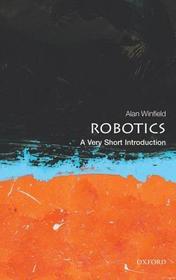
Robotics is a key technology in the modern world. Yet, despite these successes, robots have failed to live up to the predictions of the 1950s and 60s. In this Very Short Introduction, Alan Winfield considers how robotics can be both a success story and a disappointment, and how robots can be both ordinary and quite remarkable.
MoreLong description:
Robotics is a key technology in the modern world. Robots are a well-established part of manufacturing and warehouse automation, assembling cars or washing machines, and, for example, moving goods to and from storage racks for Internet mail order. More recently robots have taken their first steps into homes and hospitals, and seen spectacular success in planetary exploration. Yet, despite these successes, robots have failed to live up to the predictions of the 1950s and 60s, when it was widely thought - by scientists and engineers as well as the public - that by turn of the 21st century we would have intelligent robots as butlers, companions, or co-workers.
This Very Short Introduction explains how it is that robotics can be both a success story and a disappointment, how robots can be both ordinary and remarkable, and looks at their important developments in science and their applications to everyday life.
ABOUT THE SERIES: The Very Short Introductions series from Oxford University Press contains hundreds of titles in almost every subject area. These pocket-sized books are the perfect way to get ahead in a new subject quickly. Our expert authors combine facts, analysis, perspective, new ideas, and enthusiasm to make interesting and challenging topics highly readable.
Table of Contents:
Where are the intelligent robots?
Working robots: what robots do now
Biological robotics
Becoming human: humanoid and android robots
Trends in robotics research: new approaches
Robotic futures
Further reading

