

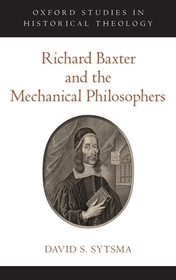
Richard Baxter and the Mechanical Philosophers
Series: Oxford Studies in Historical Theology;
- Publisher's listprice GBP 115.00
-
51 922 Ft (49 450 Ft + 5% VAT)
The price is estimated because at the time of ordering we do not know what conversion rates will apply to HUF / product currency when the book arrives. In case HUF is weaker, the price increases slightly, in case HUF is stronger, the price goes lower slightly.
- Discount 10% (cc. 5 192 Ft off)
- Discounted price 46 730 Ft (44 505 Ft + 5% VAT)
Subcribe now and take benefit of a favourable price.
Subscribe
51 922 Ft

Availability
printed on demand
Why don't you give exact delivery time?
Delivery time is estimated on our previous experiences. We give estimations only, because we order from outside Hungary, and the delivery time mainly depends on how quickly the publisher supplies the book. Faster or slower deliveries both happen, but we do our best to supply as quickly as possible.
Product details:
- Publisher OUP USA
- Date of Publication 24 August 2017
- ISBN 9780190274870
- Binding Hardback
- No. of pages354 pages
- Size 236x155x20 mm
- Weight 590 g
- Language English 0
Categories
Short description:
Richard Baxter, one of the seventeenth century's most famous Puritans, is known as an author of devotional literature. But he was also skilled in medieval philosophy. In this book, David Sytsma draws on largely unexamined works to present a chronogolical and thematic account of Baxter's relation to the people and concepts involved in the rise of mechanical philosophy in late-seventeenth-century England.
MoreLong description:
Richard Baxter, one of the most famous Puritans of the seventeenth century, is generally known as a writer of practical and devotional literature. But he also excelled in knowledge of medieval and early modern scholastic theology, and was conversant with a wide variety of seventeenth-century philosophies. Baxter was among the early English polemicists to write against the mechanical philosophy of René Descartes and Pierre Gassendi in the years immediately following the establishment of the Royal Society. At the same time, he was friends with Robert Boyle and Matthew Hale, corresponded with Joseph Glanvill, and engaged in philosophical controversy with Henry More. In this book, David Sytsma presents a chronological and thematic account of Baxter's relation to the people and concepts involved in the rise of mechanical philosophy in late-seventeenth-century England.
Drawing on largely unexamined works, including Baxter's Methodus Theologiae Christianae (1681) and manuscript treatises and correspondence, Sytsma discusses Baxter's response to mechanical philosophers on the nature of substance, laws of motion, the soul, and ethics. Analysis of these topics is framed by a consideration of the growth of Christian Epicureanism in England, Baxter's overall approach to reason and philosophy, and his attempt to understand creation as an analogical reflection of God's power, wisdom, and goodness, understood as vestigia Trinitatis. Baxter's views on reason, analogical knowledge of God, and vestigia Trinitatis draw on medieval precedents and directly inform a largely hostile, though partially accommodating, response to mechanical philosophy.
Sytsma's impressive work offers not only a more nuanced and accurate understanding of the so-called Enlightenment, but an appreciation of phiIosophy and theology as complements. Sytsma's breadth and depth, especially his ability to connect Baxter's work to a vanety of traditions and authors, enables a remarkable work of scholarship.
Table of Contents:
Abbreviations
Preface
I. Richard Baxter as Philosophical Theologian
II. Baxter and the Rise of Mechanical Philosophy
The Reception of Gassendi's Christian Epicureanism in England
Baxter's Early Response to Hobbes' Leviathan
The Beginning of Baxter's Restoration Polemics
Matthew Hale and the Growth of Baxter's Polemics
On the "Epicurean" Ethics of Hobbes and Spinoza
Baxter and Henry More
Conclusion
III. Reason and Philosophy
Works on Reason
The Nature and States of Reason
Reason and Will
Reason in the State of Sin
Reason and Revelation
The Use and Limits of Philosophy
Conclusion
IV. A Trinitarian Natural Philosophy
I. Theological Motivations
God's Two Books
Mosaic Physics
Vestigia Trinitatis
Trinitarian Analogy of Being
II. Trinities in Nature
Baxter's Eclectic Reception of Tommaso Campanella
Threefold Causality
Passive Nature
Active Nature
Conclusion
V. A Commotion over Motion
Copernicanism
The Nature of Motion
Substantial Form
Descartes' Laws of Motion
Henry More's "Mixt Mechanicall Philosophy"
Conclusion
VI. The Incipient Materialism of Mechanical Philosophy
Mechanical Philosophy and the Immaterial Soul
Henry More's "Slippery Ground" and Pierre Gassendi's "Feeble" Proofs
Pierre Gassendi, Thomas Willis, and the Material Soul
Conclusion
VII. From "Epicurean" Physics to Ethics
Baxter and Reformed Natural-Law Theory
The Specter of Necessitarianism
The Problem of Naturalistic Natural Law
Conclusion
VIII. Conclusion
Appendix A Chronology of Baxter's Post-Restoration Writings on Philosophy
Appendix B Richard Baxter to Joseph Glanvill, 18 November 1670
Appendix C Richard Baxter on Thomas Willis, De anima brutorum (1672)
Bibliography

