

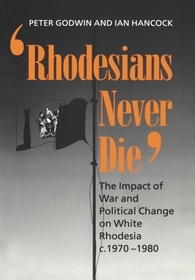
Rhodesians Never Die
The Impact of War and Political Change on White Rhodesia c.1970-1980
- Publisher's listprice GBP 152.50
-
68 853 Ft (65 575 Ft + 5% VAT)
The price is estimated because at the time of ordering we do not know what conversion rates will apply to HUF / product currency when the book arrives. In case HUF is weaker, the price increases slightly, in case HUF is stronger, the price goes lower slightly.
- Discount 10% (cc. 6 885 Ft off)
- Discounted price 61 968 Ft (59 018 Ft + 5% VAT)
Subcribe now and take benefit of a favourable price.
Subscribe
68 853 Ft

Availability
printed on demand
Why don't you give exact delivery time?
Delivery time is estimated on our previous experiences. We give estimations only, because we order from outside Hungary, and the delivery time mainly depends on how quickly the publisher supplies the book. Faster or slower deliveries both happen, but we do our best to supply as quickly as possible.
Product details:
- Publisher OUP Oxford
- Date of Publication 25 March 1993
- ISBN 9780198203650
- Binding Hardback
- No. of pages416 pages
- Size 240x164x29 mm
- Weight 758 g
- Language English 0
Categories
Short description:
The authors examine the values and beliefs of White Rhodesia, exploring the fundamental nature of its racial and national identity. They assess how White Rhodesians, ill-prepared for war and revolutionary change as they ware in 1970, reacted to the challenge to and eventual loss of their domain. This is the story of how Rhodesia became Zimbabwe.
MoreLong description:
This book tells the story of how White Rhodesians, three-quarters of whom were ill-prepared for revolutionary change, reacted to the `terrorist' war and the onset of Black rule in the 1970s. It shows how internal divisions - both old and new - undermined the supposed unity of White Rhodesia, how most Rhodesians begrudgingly accepted the inevitability of Black majority rule without adjusting to its implications, and how the self-appointed defenders of Western civilization sometimes adopted uncivilized methods of protecting the 'Rhodesian way of life'.
This is a lively and accessible account, based on careful archival research and numerous personal interviews. It sets out to tell the story from the inside and to incorporate the diverse dimensions of the Rhodesian experience. The authors suggest that the Rhodesians were more differentiated than has often been assumed and that perhaps their greatest fault was an almost infinite capacity for self-delusion.
thorough but fair examination

