

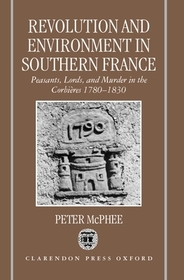
Revolution and Environment in Southern France
Peasants, Lords, and Murder in the Corbières 1780-1830
- Publisher's listprice GBP 190.00
-
85 785 Ft (81 700 Ft + 5% VAT)
The price is estimated because at the time of ordering we do not know what conversion rates will apply to HUF / product currency when the book arrives. In case HUF is weaker, the price increases slightly, in case HUF is stronger, the price goes lower slightly.
- Discount 10% (cc. 8 579 Ft off)
- Discounted price 77 207 Ft (73 530 Ft + 5% VAT)
Subcribe now and take benefit of a favourable price.
Subscribe
85 785 Ft

Availability
printed on demand
Why don't you give exact delivery time?
Delivery time is estimated on our previous experiences. We give estimations only, because we order from outside Hungary, and the delivery time mainly depends on how quickly the publisher supplies the book. Faster or slower deliveries both happen, but we do our best to supply as quickly as possible.
Product details:
- Publisher Clarendon Press
- Date of Publication 3 June 1999
- ISBN 9780198207177
- Binding Hardback
- No. of pages288 pages
- Size 224x144x21 mm
- Weight 455 g
- Language English
- Illustrations 6 figures, 4 maps 0
Categories
Short description:
In the forty years after the Revolution of 1789, the peasants and former seigneurs of the isolated and arid region of the Corbières, Languedoc, fought a protracted battle over the consequences of revolutionary change. This social conflict culminated in the murder of two nobles by a band of villagers in the aftermath of the Revolution of 1830. Professor McPhee's book offers important new perspectives on the French Revolution and its consequences.
MoreLong description:
In the forty years after the Revolution of 1789, the peasants and former seigneurs of the isolated and arid region of the Corbières, Languedoc, fought a protracted battle over the consequences of revolutionary change. Central to this conflict was control of the rough hillsides or garrigues used as sheep pastures, which the poorer peasantry seized and cleared. This social conflict culminated in the murder of two nobles by a band of villagers in the aftermath of the Revolution of 1830.
Professor McPhee's book highlights two significant new perspectives on the Revolution of 1789. First, the actions of poorer peasants in massive land-clearance occasioned an impassioned debate about the environmental consequences of uncontrolled tree-felling. Secondly, much of the cleared land was used for vineyards, suggesting the importance of far-reaching changes initiated by the poorest sections of the community.
This concise and elegant book engages important issues in the history of rural France by analyzing in depth the impact of the French Revolution on a small region of lower Languedoc known as the Corbières ... McPhee's study breaks new ground in its analysis of the environmental impact of the Revolution on the Corbières.

