

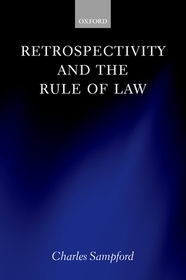
Retrospectivity and the Rule of Law
- Publisher's listprice GBP 167.50
-
75 626 Ft (72 025 Ft + 5% VAT)
The price is estimated because at the time of ordering we do not know what conversion rates will apply to HUF / product currency when the book arrives. In case HUF is weaker, the price increases slightly, in case HUF is stronger, the price goes lower slightly.
- Discount 10% (cc. 7 563 Ft off)
- Discounted price 68 064 Ft (64 823 Ft + 5% VAT)
Subcribe now and take benefit of a favourable price.
Subscribe
75 626 Ft

Availability
printed on demand
Why don't you give exact delivery time?
Delivery time is estimated on our previous experiences. We give estimations only, because we order from outside Hungary, and the delivery time mainly depends on how quickly the publisher supplies the book. Faster or slower deliveries both happen, but we do our best to supply as quickly as possible.
Product details:
- Publisher OUP Oxford
- Date of Publication 23 March 2006
- ISBN 9780198252986
- Binding Hardback
- No. of pages336 pages
- Size 242x163x26 mm
- Weight 663 g
- Language English 0
Categories
Short description:
However controverial, retrospective rule-making is not at all uncommon and has been used by governments of all political persuasions for incarcerating terrorists to closing tax loopholes, and by courts of no political persuasion in developing and refining the common law. This book examines the nature of retrospective rule making and the arguments for and against it. The book concludes that there is one important argument against retrospective laws based on the rule of law, but this does not apply in all instances, and in some cases even demonstrates the need for retrospective laws. This has profound implications for our understanding of the rule of law, of law itself and for the ideal of a well-ordered society.
MoreLong description:
Retrospective rule-making has few supporters and many opponents. Defenders of retrospective laws generally do so on the basis that they are a necessary evil in specific or limited circumstances, for example to close tax loopholes, to deal with terrorists or to prosecute fallen tyrants. Yet the reality of retrospective rule making is far more widespread than this, and ranges from 'corrective' legislation to 'interpretive regulations' to judicial decision making. The search for a rational justification for retrospective rule-making necessitates a reconsideration of the very nature of the rule of law and the kind of law that can rule, and will provide new insights into the nature of law and the parameters of societal order.
This book examines the various ways in which laws may be seen as retrospective and analyses the problems in defining retrospectivity. In his analysis Dr Charles Sampford asserts that the definitive argument against retrospective rule-making is the expectation of individuals that, if their actions today are considered by a future court, the applicable law was discoverable at the time the action was performed. The book goes on to suggest that although the strength of this 'rule of law' argument should prevail in general, exceptions are sometimes necessary, and that there may even be occasions when analysis of the rule of law may provide the foundation for the application of retrospective laws.
Anyone who desires to write or think about problems of legal retrospectivity or the rule of law must read and refer to this excellent book.
Table of Contents:
Defining Retrospectivity
The Rule of Law
Arguments Against Retrospective Law
Retrospective Legislation
Retrospective Judicial Law-Making
Justifications for Retrospective Law
Conclusions and Consequences for the Rule of Law

