

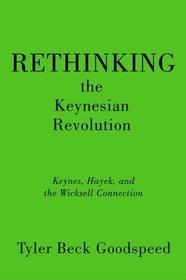
Rethinking the Keynesian Revolution
Keynes, Hayek, and the Wicksell Connection
- Publisher's listprice GBP 78.00
-
35 217 Ft (33 540 Ft + 5% VAT)
The price is estimated because at the time of ordering we do not know what conversion rates will apply to HUF / product currency when the book arrives. In case HUF is weaker, the price increases slightly, in case HUF is stronger, the price goes lower slightly.
- Discount 10% (cc. 3 522 Ft off)
- Discounted price 31 695 Ft (30 186 Ft + 5% VAT)
Subcribe now and take benefit of a favourable price.
Subscribe
35 217 Ft

Availability
printed on demand
Why don't you give exact delivery time?
Delivery time is estimated on our previous experiences. We give estimations only, because we order from outside Hungary, and the delivery time mainly depends on how quickly the publisher supplies the book. Faster or slower deliveries both happen, but we do our best to supply as quickly as possible.
Product details:
- Publisher OUP USA
- Date of Publication 26 July 2012
- ISBN 9780199846658
- Binding Hardback
- No. of pages216 pages
- Size 208x142x17 mm
- Weight 376 g
- Language English
- Illustrations 10 illustrations 0
Categories
Short description:
While standard accounts of the 1930s debates surrounding economic thought pit John Maynard Keynes against Friedrich von Hayek in a clash of ideology, this reflexive dichotomy is in many respects superficial. It is the argument of this book that both Keynes and Hayek developed their respective theories of the business cycle within the tradition of Swedish economist Knut Wicksell, and that this shared genealogy manifested itself in significant theoretical affinities between the two supposed antagonists.
MoreLong description:
While standard accounts of the 1930s debates surrounding economic thought pit John Maynard Keynes against Friedrich von Hayek in a clash of ideology, this reflexive dichotomy is in many respects superficial. It is the argument of this book that both Keynes and Hayek developed their respective theories of the business cycle within the tradition of Swedish economist Knut Wicksell, and that this shared genealogy manifested itself in significant theoretical affinities between the two supposed antagonists. The salient features of Wicksell's work, namely the importance of money, the role of uncertainty, coordination failures, and the element of time in capital accumulation, all motivated the Keynesian and Hayekian theories of economic fluctuations. They also contributed to a fundamental convergence between the two economists during the 1930s. This shared, 'Wicksellian' vision of economic problems points to a very different research agenda from that of the Walrasian-style, general equilibrium analysis that has dominated postwar macroeconomics.
This book will appeal to economists interested in historical perspective of their discipline, as well as historians of economic thought. The author not only deconstructs some of the historical misconceptions of the Keynes versus Hayek debate, but also suggests how the insights uncovered can inform and instruct modern theory. While much of the analysis is technical, it does not assume previous knowledge of 1930s economic theory, and should be accessible to economists, political scientists, and historians with general economics training, as well as to graduate students in these fields.
Goodspeed has here provided a solid, techinal and historical recounting of the older Cambridge Capital Controversies that will be quite useful for scholars interested in Keynes, Hayek, and the economics that issued from Cambridge.
Table of Contents:
Introduction: Rethinking the Keynesian Revolution
1. The Wicksell Connection
1.1. Wicksell's Monetary Theory
1.2. Wicksell's Capital Theory
1.3. The Wicksell Connection
2. A Treatise vs. Prices and Production
2.1. A Treatise on Money
2.2. Prices and Production
2.3. The Wicksell Connection
3. The Sraffa Connection
3.1. Hayek on Keynes
3.2. Keynes on Hayek
3.3. Sraffa on Hayek
4. The General Theory
4.1. Own-Rates of Interest and the Marginal Efficiency of Capital
4.2. Liquidity Preference
4.3. The Cumulative Process
5. Pure Theory of Capital
5.1. Rates of Increase of the Product
5.2. Marginal Value Product of Investment
5.3. The Cumulative Process
6: Keynes, Hayek, and the Wicksell Connection
Bibliography

