

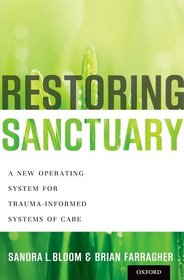
Restoring Sanctuary
A New Operating System for Trauma-Informed Systems of Care
- Publisher's listprice GBP 76.00
-
34 314 Ft (32 680 Ft + 5% VAT)
The price is estimated because at the time of ordering we do not know what conversion rates will apply to HUF / product currency when the book arrives. In case HUF is weaker, the price increases slightly, in case HUF is stronger, the price goes lower slightly.
- Discount 10% (cc. 3 431 Ft off)
- Discounted price 30 883 Ft (29 412 Ft + 5% VAT)
Subcribe now and take benefit of a favourable price.
Subscribe
34 314 Ft

Availability
printed on demand
Why don't you give exact delivery time?
Delivery time is estimated on our previous experiences. We give estimations only, because we order from outside Hungary, and the delivery time mainly depends on how quickly the publisher supplies the book. Faster or slower deliveries both happen, but we do our best to supply as quickly as possible.
Product details:
- Publisher OUP USA
- Date of Publication 14 February 2013
- ISBN 9780199796366
- Binding Hardback
- No. of pages336 pages
- Size 160x226x48 mm
- Weight 612 g
- Language English 0
Categories
Short description:
This book explores the notion that organizations are living systems themselves and as such they manifest various degrees of health and dysfunction, analogous to those of individuals. Becoming trauma-informed as a system means healing as a system and that frequently necessitates the repairing of deficits in basic social and political skills that are necessary for democratic practice in any setting.
MoreLong description:
This is the third in a trilogy of books that chronicle the revolutionary changes in our mental health and human service delivery systems that have conspired to disempower staff and hinder client recovery. Creating Sanctuary documented the evolution of The Sanctuary Model therapeutic approach as an antidote to the personal and social trauma that clients bring to child welfare agencies, psychiatric hospitals, and residential facilities. Destroying Sanctuary details the destructive role of organizational trauma in the nation's systems of care. Restoring Sanctuary is a user-friendly manual for organizational change that addresses the deep roots of toxic stress and illustrates how to transform a dysfunctional human service system into a safe, secure, trauma-informed environment.
At its heart, The Sanctuary Model represents an organizational value system that is committed to seven principles, which serve as anchors for decision making at all levels: non-violence, emotional intelligence, social learning, democracy, open communication, social responsibility, and growth and change. The Sanctuary Model is not a clinical intervention; rather, it is a method for creating an organizational culture that can more effectively provide a cohesive context within which healing from psychological and socially derived forms of traumatic experience can be addressed. Chapters are organized around the seven Sanctuary commitments, providing step-by-step, realistic guidance on creating and sustaining fundamental change.
"Restoring Sanctuary" is a roadmap to recovery for our nation's systems of care. It explores the notion that organizations are living systems themselves and as such they manifest various degrees of health and dysfunction, analogous to those of individuals. Becoming a truly trauma-informed system therefore requires a process of reconstitution within helping organizations, top to bottom. A system cannot be truly trauma-informed unless the system can create and sustain a process of understanding itself.
Table of Contents:
Chapter 1: It Starts with a Dream
Chapter 2: Turning imagination into Reality: A Vision of Health
Chapter 3: Growth and Change: Isn't This the Whole Point?
Chapter 4: Commitment to Democracy
Chapter 5: Commitment to Nonviolence
Chapter 6: Commitment to Emotional Intelligence
Chapter 7: Commitment to Social Learning
Chapter 8: Commitment to Open Communication
Chapter 9: Commitment to Social Responsibility
Chapter 10: Pulling It All Together

