

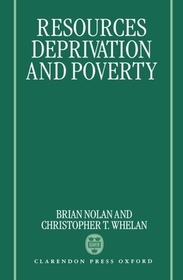
Resources, Deprivation, and Poverty
- Publisher's listprice GBP 175.00
-
79 012 Ft (75 250 Ft + 5% VAT)
The price is estimated because at the time of ordering we do not know what conversion rates will apply to HUF / product currency when the book arrives. In case HUF is weaker, the price increases slightly, in case HUF is stronger, the price goes lower slightly.
- Discount 10% (cc. 7 901 Ft off)
- Discounted price 71 111 Ft (67 725 Ft + 5% VAT)
Subcribe now and take benefit of a favourable price.
Subscribe
79 012 Ft

Availability
printed on demand
Why don't you give exact delivery time?
Delivery time is estimated on our previous experiences. We give estimations only, because we order from outside Hungary, and the delivery time mainly depends on how quickly the publisher supplies the book. Faster or slower deliveries both happen, but we do our best to supply as quickly as possible.
Product details:
- Publisher Clarendon Press
- Date of Publication 30 May 1996
- ISBN 9780198287858
- Binding Hardback
- No. of pages272 pages
- Size 248x164x21 mm
- Weight 561 g
- Language English
- Illustrations tables 0
Categories
Short description:
The core issue of this book is how to define and measure poverty in relatively rich countries in a way which is valid, meaningful in the context, and valuable for policy-making. The authors concentrate on the identification of the poor, rather than the subsequent aggregation of the statistics to derive an overall index of poverty - which is the focus of most recent literature. They show that poverty in developed countries cannot be understood and measured simply using current income. Those who are excluded from participation in society can be more accurately identified if broader measures of resources and direct idicators of deprivation are used. The issues are illustrated by data from a specially designed survey of a large representative sample of Irish households.
MoreLong description:
Poverty alleviation is a central aim of economic and social policy, and yet there is no consensus about what poverty means or how it is best measured. Often, the households below an income poverty line are counted as poor, but there may be no firm basis for concentrating on that particular income level. There may also be wide variations among the households below any income poverty line in terms of their actual living standards. This book explores what poverty means in developed countries, and shows that understanding and measuring it requires widening the focus beyond curent income. By using broader measures of resources and information on living patterns and concrete indicators of deprivation, it shows how those who are effectively excluded from participation in society due to a lack of resources can be more accurately identified, and the processes producing such exclusion better understood. The core issue of this book is how to define and measure poverty in relatively rich countries in a way which is valid, meaningful in the context, and valuable for policy-making. Extensive tables of data from a specially designed survey of a large representative sample of Irish households are used to illustrate this issue.
Readers of this journal will be all too familiar with the questions which have bedevilled research on poverty ... This authoritative study makes a significant contribution to these and related questions ... This book should make a significant contribution to the analysis of poverty and social inequality. It offers a rigorous, ingenious and original contribution to some of the most stubborn methodological problems in recent poverty research ... For the 'professionals' in the poverty research business ... the book is, quite simply, essential reading.
Table of Contents:
Introduction
The Meaning and Measurement of Poverty
Income Poverty
Measuring Deprivation
Income, Resources, and Deprivation
Income, Deprivation, and Poverty
Class, Underclass, and Poverty
Implications for Conceptualizing and Measuring Poverty
Conclusions
Appendices
References
Index

