

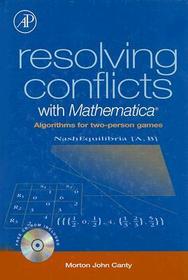
Resolving Conflicts with Mathematica
Algorithms for Two-Person Games
- Publisher's listprice EUR 98.95
-
38 649 Ft (36 809 Ft + 5% VAT)
The price is estimated because at the time of ordering we do not know what conversion rates will apply to HUF / product currency when the book arrives. In case HUF is weaker, the price increases slightly, in case HUF is stronger, the price goes lower slightly.
- Discount 10% (cc. 3 865 Ft off)
- Discounted price 34 785 Ft (33 128 Ft + 5% VAT)
Subcribe now and take benefit of a favourable price.
Subscribe
38 649 Ft

Availability
cancelled
Why don't you give exact delivery time?
Delivery time is estimated on our previous experiences. We give estimations only, because we order from outside Hungary, and the delivery time mainly depends on how quickly the publisher supplies the book. Faster or slower deliveries both happen, but we do our best to supply as quickly as possible.
Product details:
- Edition number Rev ed
- Publisher Elsevier Science
- Date of Publication 15 August 2003
- ISBN 9780121588557
- Binding Hardback
- No. of pages338 pages
- Size 228x152 mm
- Weight 790 g
- Language English 0
Categories
Long description:
The revised and updated edition of this popular German textbook is unique in its emphasis on algorithmic methods and in its original use of Mathematica as a tool to obtain solutions to game-theoretical models.Resolving Conflicts with Mathematica begins with the basic theory of extensive and normal form games, as well as introducing the fundamental concept of Nash equilibria. The restriction to two-person games helps to make the material more digestible for the beginner. In later chapters the subtleties of degenerate games are discussed thoroughly. Many aspects of equilibrium selection theory are treated, including algorithms for determining evolutionary stable equilibria in biology. Finally, the book looks at the wide-scale application of game theory to practical conflict situations.Resolving Conflicts with Mathematica includes a set of Mathematica programs which implement all of the algorithms described in the text. Exercises are closely integrated with the book's material and Mathematica 'notebooks' are supplied with each of the chapters.
More
