

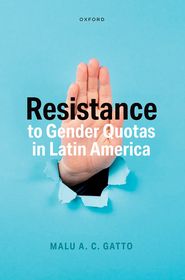
Resistance to Gender Quotas in Latin America
- Publisher's listprice GBP 84.00
-
37 926 Ft (36 120 Ft + 5% VAT)
The price is estimated because at the time of ordering we do not know what conversion rates will apply to HUF / product currency when the book arrives. In case HUF is weaker, the price increases slightly, in case HUF is stronger, the price goes lower slightly.
- Discount 20% (cc. 7 585 Ft off)
- Discounted price 30 341 Ft (28 896 Ft + 5% VAT)
- Discount is valid until: 30 June 2026
Subcribe now and take benefit of a favourable price.
Subscribe
37 926 Ft

Availability
Estimated delivery time: In stock at the publisher, but not at Prospero's office. Delivery time approx. 3-5 weeks.
Not in stock at Prospero.
Why don't you give exact delivery time?
Delivery time is estimated on our previous experiences. We give estimations only, because we order from outside Hungary, and the delivery time mainly depends on how quickly the publisher supplies the book. Faster or slower deliveries both happen, but we do our best to supply as quickly as possible.
Product details:
- Publisher OUP Oxford
- Date of Publication 15 April 2025
- ISBN 9780198935315
- Binding Hardback
- No. of pages272 pages
- Size 240x164x25 mm
- Weight 562 g
- Language English 596
Categories
Short description:
This book traces legislators' behavior towards gender quotas since the policy made its way into plenary debates. It reconstructs 30 years of power struggles over quota policymaking in Latin America and shows that men legislators are more likely to support gender quotas when opposing them could affect their future career prospects.
MoreLong description:
This is an open access title available under the terms of a CC BY-NC-ND 4.0 International license. It is free to read at Oxford Academic and offered as a free PDF download from OUP and selected open access locations.
Politicians want to stay in power. Because winners attain office under a given set of electoral rules, any change to these rules is puzzling. When electoral reform does take place, it is expected that changes will better serve those already in power. Perhaps more than any other type of electoral rule, gender quotas are explicit about who is set to win and lose from their adoption: although they limit the space for men - the clear majority of incumbents - they are nevertheless present in every region of the world. But how has this happened? In other words, under what conditions are (men) legislators more likely to support the adoption of gender quotas?
Resistance to Gender Quotas in Latin America is the first book to closely trace legislators' behavior towards gender quotas since the policy made its way into plenary debates. It reconstructs three decades of power struggles over quota policymaking in Latin America, and argues that men legislators are more likely to support gender quotas when opposition to the policy could have an impact on their future career prospects. The book draws on a wealth of experimental, quantitative, and qualitative data to show how an institution that explicitly seeks to replace incumbents has successfully spread through Latin America despite resistance from those incumbents. Malu Gatto explores the individual-level characteristics that shape legislators' resistance towards gender quotas, and provides an overview of the gradual processes through which initially weak quotas that did not impose threats to the status quo became policies that radically transformed the gender composition of legislatures. Finally, the book also explores case studies of quota policymaking in Brazil, Costa Rica, and Chile and shows that incumbents' self-preservation instincts shape their behaviors towards quotas, delaying the timing of quota adoption, weakening quota designs, and lengthening quota policymaking processes.
Table of Contents:
List of tables
List of figures
Abbreviations
Introduction
Consented defeat: A theory of strategic resistance to gender quotas
Sex, ambition, and vulnerability to displacement: Unpacking gender quota resistance
Thirty years of quota resistance in Latin America
Consistent resistance and gradual change: The case of Brazil
Changing levels of resistance and transformative change: The case of Costa Rica
High levels of resistance and abrupt change: The case of Chile
Conclusion
Appendices
References
Index

