

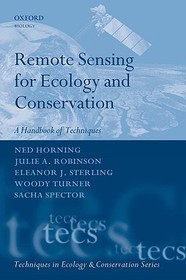
Remote Sensing for Ecology and Conservation
A Handbook of Techniques
Series: Techniques in Ecology & Conservation;
- Publisher's listprice GBP 79.00
-
35 668 Ft (33 970 Ft + 5% VAT)
The price is estimated because at the time of ordering we do not know what conversion rates will apply to HUF / product currency when the book arrives. In case HUF is weaker, the price increases slightly, in case HUF is stronger, the price goes lower slightly.
- Discount 10% (cc. 3 567 Ft off)
- Discounted price 32 102 Ft (30 573 Ft + 5% VAT)
Subcribe now and take benefit of a favourable price.
Subscribe
35 668 Ft

Availability
printed on demand
Why don't you give exact delivery time?
Delivery time is estimated on our previous experiences. We give estimations only, because we order from outside Hungary, and the delivery time mainly depends on how quickly the publisher supplies the book. Faster or slower deliveries both happen, but we do our best to supply as quickly as possible.
Product details:
- Publisher OUP Oxford
- Date of Publication 1 July 2010
- ISBN 9780199219957
- Binding Paperback
- No. of pages496 pages
- Size 229x156x24 mm
- Weight 839 g
- Language English
- Illustrations 150 illustrations in full colour 0
Categories
Short description:
Remote sensing describes the technique of collecting information from a distance. This book describes the ways that remotely sensed data from research on biodiversity and its conservation can be captured and used, especially for evaluating human impacts on ecological systems.
MoreLong description:
The work of conservation biology has grown from local studies of single species into a discipline concerned with mapping and managing biodiversity on a global scale. Remote sensing, using satellite and aerial imaging to measure and map the environment, increasingly provides a vital tool for effective collection of the information needed to research and set policy for conservation priorities. The perceived complexities of remotely sensed data and analyses have tended to discourage scientists and managers from using this valuable resource. This text focuses on making remote sensing tools accessible to a larger audience of non-specialists, highlighting strengths and limitations while emphasizing the ways that remotely sensed data can be captured and used, especially for evaluating human impacts on ecological systems.
If you are either contemplating the use of remote sensing approaches or requiring guidance in the interpretation of data obtained by this suite of methods, this book, well-illustrated in colour, is likely to be what you need ... [This] is an authoritative and pragmatic text, produced with potential and actual users in mind.
Table of Contents:
Preface
Acronyms List
Introduction: Why Ecologists and Conservation Biologists Use Remote Sensing
When to Use Remote Sensing
Working with Images
Measuring and Monitoring Land Cover, Land Use, and Vegetation Characteristics
Terrain and Soils
Marine and Coastal Environments
Wetlands-Estuaries, Inland Wetlands, and Freshwater Lakes
Atmosphere and Climate
Disturbances: Fires and Floods
Landscape Fragmentation
Human Interfaces and Urban Change
Protected Area Design and Monitoring
Integrating Field Data
Linking Remote Sensing with Modeling
Global Conservation
Appendix 1 The Electromagnetic Spectrum
Appendix 2 Image Processing Software
Appendix 3 Open Source Software
Appendix 4 Satellites and Sensors
Appendix 5 Visual Interpretation
Appendix 6 Systems for Observing Climate and Atmospheric Phenomena
References
Index

