

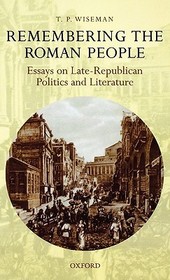
Remembering the Roman People
Essays on Late-Republican Politics and Literature
- Publisher's listprice GBP 170.00
-
81 217 Ft (77 350 Ft + 5% VAT)
The price is estimated because at the time of ordering we do not know what conversion rates will apply to HUF / product currency when the book arrives. In case HUF is weaker, the price increases slightly, in case HUF is stronger, the price goes lower slightly.
- Discount 10% (cc. 8 122 Ft off)
- Discounted price 73 096 Ft (69 615 Ft + 5% VAT)
Subcribe now and take benefit of a favourable price.
Subscribe
81 217 Ft

Availability
printed on demand
Why don't you give exact delivery time?
Delivery time is estimated on our previous experiences. We give estimations only, because we order from outside Hungary, and the delivery time mainly depends on how quickly the publisher supplies the book. Faster or slower deliveries both happen, but we do our best to supply as quickly as possible.
Product details:
- Publisher OUP Oxford
- Date of Publication 25 December 2008
- ISBN 9780199239764
- Binding Hardback
- No. of pages288 pages
- Size 223x144x18 mm
- Weight 521 g
- Language English
- Illustrations 3 line drawings, 3 photographs 0
Categories
Short description:
A challenging reinterpretation of the political culture of the last century of the Roman Republic. T. P. Wiseman argues that the People had their own egalitarian ethos, usually in conflict with that of the self-styled `best' (optimates), who, with their belief in justified murder, were responsible for the republic's breakdown in civil war.
MoreLong description:
In the Roman republic, only the People could pass laws, only the People could elect politicians to office, and the very word republica meant 'the People's business'. So why is it always assumed that the republic was an oligarchy? The main reason is that most of what we know about it we know from Cicero, a great man and a great writer, but also an active right-wing politician who took it for granted that what was good for a small minority of self-styled 'best people' (optimates) was good for the republic as a whole. T. P. Wiseman interprets the last century of the republic on the assumption that the People had a coherent political ideology of its own, and that the optimates, with their belief in justified murder, were responsible for the breakdown of the republic in civil war.
This book is ground-breaking for its simple suggestion that the ideology of Roman popular politics is not entirely lost to us, and for its virtuoso demonstration that, fragmentary, inadequate and intensively studied as our sources for the pe riod are, they may still have more to tell us.
Table of Contents:
Roman History and the Ideological Vacuum
The Fall and Rise of Gaius Geta
Licinius Macer, Juno Moneta and Veiovis
Romulus' Rome of Equals
Macaulay on Cicero
Cicero and Varro
Marcopolis
The Political Stage
The Ethics of Murder
After the Ides of March
Epilogue

