

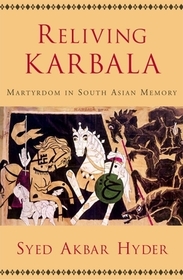
Reliving Karbala
Martyrdom in South Asian Memory
- Publisher's listprice GBP 72.00
-
32 508 Ft (30 960 Ft + 5% VAT)
The price is estimated because at the time of ordering we do not know what conversion rates will apply to HUF / product currency when the book arrives. In case HUF is weaker, the price increases slightly, in case HUF is stronger, the price goes lower slightly.
- Discount 10% (cc. 3 251 Ft off)
- Discounted price 29 257 Ft (27 864 Ft + 5% VAT)
Subcribe now and take benefit of a favourable price.
Subscribe
32 508 Ft

Availability
printed on demand
Why don't you give exact delivery time?
Delivery time is estimated on our previous experiences. We give estimations only, because we order from outside Hungary, and the delivery time mainly depends on how quickly the publisher supplies the book. Faster or slower deliveries both happen, but we do our best to supply as quickly as possible.
Product details:
- Publisher OUP USA
- Date of Publication 11 May 2006
- ISBN 9780195189308
- Binding Hardback
- No. of pages278 pages
- Size 163x239x25 mm
- Weight 547 g
- Language English
- Illustrations 14 halftones 0
Categories
Short description:
In 680 CE, the prophet Muhammad's grandson, Husain, led a small band of followers in rebellion against the caliph, Yazid. Husain and his followers were slain at Karbala, in modern-day Iraq, leading to the split between Sunni and Shiite Muslims that persists to this day. Syed Akbar Hyder examines the myriad ways that the story of Karbala has been used in South Asia - the region that is home to the largest number of Muslims, along with many non-Muslims who have adopted Islamic cultural and historical idioms. Tracing the development of the story from the earliest historical sources to the beginning of the twenty-first century, Hyder demonstrates the incredible flexibility of the idea of "Karbala". For millions of Muslims, Karbala serves as the archetypal martyrdom story, but Hyder shows that this is far from the only way the tale is used. In fact, he demonstrates, Karbala means many things to many people, and is even invoked in contexts that are explicitly anti-religious. It serves as a celebration of martyrdom, a source of personal and communal identity, and even a tool for political protest and struggle. through his multifaceted examination of this seminal story in Islamic history, Hyder offers an original, complex, and nuanced view of Islamic martyrdom.
MoreLong description:
In 680 CE, the prophet Muhammad's grandson, Husain, led a small band of followers in rebellion against the caliph, Yazid. Husain and his followers were slain at Karbala, in modern-day Iraq, leading to the split between Sunni and Shiite Muslims that persists to this day. Syed Akbar Hyder examines the myriad ways that the story of Karbala has been used in South Asia - the region that is home to the largest number of Muslims, along with many non-Muslims who have adopted Islamic cultural and historical idioms. Tracing the development of the story from the earliest historical sources to the beginning of the twenty-first century, Hyder demonstrates the incredible flexibility of the idea of "Karbala". For millions of Muslims, Karbala serves as the archetypal martyrdom story, but Hyder shows that this is far from the only way the tale is used. In fact, he demonstrates, Karbala means many things to many people, and is even invoked in contexts that are explicitly anti-religious. It serves as a celebration of martyrdom, a source of personal and communal identity, and even a tool for political protest and struggle. through his multifaceted examination of this seminal story in Islamic history, Hyder offers an original, complex, and nuanced view of Islamic martyrdom.
Reliving Karbala is a significant contribution to the existing scholarship on Karbala. Hyder adds vitality and depth to his analysis through a range of personal anecdotes, including memories of his own experience of growing up between cultures. This book is an invaluable resource from whcih students of various disciplines will benefit.

