

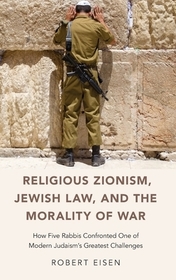
Religious Zionism, Jewish Law, and the Morality of War
How Five Rabbis Confronted One of Modern Judaism's Greatest Challenges
- Publisher's listprice GBP 47.49
-
22 688 Ft (21 607 Ft + 5% VAT)
The price is estimated because at the time of ordering we do not know what conversion rates will apply to HUF / product currency when the book arrives. In case HUF is weaker, the price increases slightly, in case HUF is stronger, the price goes lower slightly.
- Discount 10% (cc. 2 269 Ft off)
- Discounted price 20 419 Ft (19 446 Ft + 5% VAT)
Subcribe now and take benefit of a favourable price.
Subscribe
22 688 Ft

Availability
printed on demand
Why don't you give exact delivery time?
Delivery time is estimated on our previous experiences. We give estimations only, because we order from outside Hungary, and the delivery time mainly depends on how quickly the publisher supplies the book. Faster or slower deliveries both happen, but we do our best to supply as quickly as possible.
Product details:
- Publisher OUP USA
- Date of Publication 30 November 2017
- ISBN 9780190687090
- Binding Hardback
- No. of pages312 pages
- Size 239x155x30 mm
- Weight 658 g
- Language English 0
Categories
Short description:
This study is a pioneering exploration of how rabbis in the religious Zionist community in Israel constructed a body of Jewish law on war. It focuses on five leading rabbis in this camp and how they dealt with a number of key moral issues that the waging of war raised.
MoreLong description:
When the state of Israel was established in 1947, it was immediately thrust into war, and rabbis in the religious Zionist community were confronted with the formidable challenge of constructing a body of Jewish law to deal with this turn of events. A body of law had to be "constructed" here because Jewish law had developed mostly during prior centuries when Jews had neither a state nor an army, and therefore it did not include much material on war. Leading rabbis in the religious Zionist camp responded to this challenge with remarkable ingenuity and creativity. They used their interpretive skills to greatly expand the little material on war in Jewish law that already existed. They also used those skills to draw out insights from other areas of Jewish law that could be applied to war. The result was a substantial corpus of law on war where almost none had existed before.
The work of these rabbis represents a fascinating chapter in the history of Jewish law and ethics, but it has attracted relatively little attention from academics. This book is a pioneering attempt to make up for that shortfall. It examines how five leading rabbis in the religious Zionist community in the twentieth century dealt with key moral issues in war. Chapters are devoted to R. Abraham Isaac Kook, R. Isaac Halevi Herzog, and R. Eliezer Waldenberg, R. Sha'ul Yisraeli, and R. Shlomo Goren. The moral issues examined include the question of who is a legitimate authority for waging war, why Jews in a modern Jewish state can be drafted to fight on its behalf, and under what circumstances the killing of enemy civilians is permitted. This study also examines how the positions of these rabbis on such issues compare to those of international law.
Eisen has done a great service by bringing the thoughts of these rabbis, whose Hebrew works remain largely untranslated, to English readers. Furthermore, the clarity and organization of the book makes it potentially useful for undergraduate courses.
Table of Contents:
Preface
Abbreviations
Chapter One: Introduction
Chapter Two: War in Jewish Law Before Zionism
Chapter Three: R. Abraham Isaac Kook
Chapter Four: R. Isaac Halevi Herzog
Chapter Five: R. Eliezer Yehudah Waldenberg
Chapter Six: R. Sha'ul Yisraeli: The Essay on Kibiyeh
Chapter Seven: R. Sha'ul Yisraeli: The Later Writings
Chapter Eight: R. Shlomo Goren
Chapter Nine: Summary and Conclusions
Works Cited

