

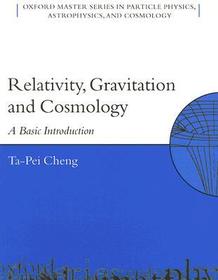
Relativity, Gravitation and Cosmology
A Basic Introduction
Series: Oxford Master Series in Physics; 11;
- Publisher's listprice GBP 33.99
-
15 346 Ft (14 615 Ft + 5% VAT)
The price is estimated because at the time of ordering we do not know what conversion rates will apply to HUF / product currency when the book arrives. In case HUF is weaker, the price increases slightly, in case HUF is stronger, the price goes lower slightly.
- Discount 10% (cc. 1 535 Ft off)
- Discounted price 13 811 Ft (13 154 Ft + 5% VAT)
Subcribe now and take benefit of a favourable price.
Subscribe
15 346 Ft

Availability
Uncertain availability. Please turn to our customer service.
Why don't you give exact delivery time?
Delivery time is estimated on our previous experiences. We give estimations only, because we order from outside Hungary, and the delivery time mainly depends on how quickly the publisher supplies the book. Faster or slower deliveries both happen, but we do our best to supply as quickly as possible.
Product details:
- Publisher OUP Oxford
- Date of Publication 16 December 2004
- ISBN 9780198529576
- Binding Paperback
- No. of pages360 pages
- Size 246x190x19 mm
- Weight 773 g
- Language English
- Illustrations numerous line figures 0
Categories
Short description:
This book is an introduction to Einstein's general theory of relativity, suitable for advanced undergraduate or beginning graduate courses. The content is structured so that interesting applications, such as gravitational lensing, black holes and cosmology, can be presented without the readers having to first learn the difficult mathematics of tensor calculus. The mathematical accessibility and the presentation of the book make it practical for readers to study the
subject on their own.
Long description:
Einstein's general theory of relativity is introduced in this advanced undergraduate and beginning graduate level textbook. Topics include special relativity in the formalism of Minkowski's four-dimensional space-time, the principle of equivalence, Riemannian geometry and tensor analysis, Einstein's field equation and cosmology.
The author presents the subject from the very beginning with an emphasis on physical examples and simple applications without the full tensor apparatus. One first learns how to describe curved spacetime. At this mathematically more accessible level, the reader can already study the many interesting phenomena such as gravitational lensing, precession of Mercury's perihelion, black holes, as well as cosmology. The full tensor formulation is presented later, when the Einstein equation is solved
for a few symmetric cases. Many modern topics in cosmology are discussed in this book: from inflation and cosmic microwave anisotropy to the "dark energy" that propels an accelerating universe.
Mathematical accessibility, together with the various pedagogical devices (e.g., worked-out solutions of chapter-end problems), make it practical for interested readers to use the book to study general relativity, gravitation and cosmology on their own.
This is a great time to have published a fresh new undergraduate text on relativity and cosmology...this is an excellent textbook which this reviewer would rate as the text of choice for a course on relativity and cosmology aimed at physics and astronomy undergraduates. American Journal of Physics, October 2005.
Table of Contents:
Relativity - metric description of spacetime
Introduction and overview
Special relativity and the flat spacetime
The principle of equivalence
Metric description of a curved space
General relativity (GR) as a geometric theory of gravity - I
Spacetime outside a spherical star
Cosmology
The homogenous and isotropic universe
The expanding universe and thermal relics
Inflation and the accelerating universe
Relativity - full tensor formulation
Tensors in special relativity
Tensors in general relativity
GR as a geometric theory of gravity - II
Linearized theory and gravitational waves

