

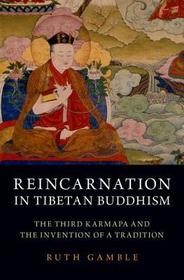
Reincarnation in Tibetan Buddhism
The Third Karmapa and the Invention of a Tradition
- Publisher's listprice GBP 96.00
-
43 344 Ft (41 280 Ft + 5% VAT)
The price is estimated because at the time of ordering we do not know what conversion rates will apply to HUF / product currency when the book arrives. In case HUF is weaker, the price increases slightly, in case HUF is stronger, the price goes lower slightly.
- Discount 10% (cc. 4 334 Ft off)
- Discounted price 39 010 Ft (37 152 Ft + 5% VAT)
Subcribe now and take benefit of a favourable price.
Subscribe
43 344 Ft

Availability
printed on demand
Why don't you give exact delivery time?
Delivery time is estimated on our previous experiences. We give estimations only, because we order from outside Hungary, and the delivery time mainly depends on how quickly the publisher supplies the book. Faster or slower deliveries both happen, but we do our best to supply as quickly as possible.
Product details:
- Publisher OUP USA
- Date of Publication 6 September 2018
- ISBN 9780190690779
- Binding Hardback
- No. of pages340 pages
- Size 157x239x33 mm
- Weight 599 g
- Language English 0
Categories
Short description:
Reincarnation in Tibetan Buddhism examines how the third Karmapa hierarch, Rangjung Dorjé (1284-1339) transformed reincarnation from a belief into a Tibetan tradition. It surveys his life through the portal of his previously untranslated autobiographical stories and songs, which reveal how his contribution to this tradition's invention.
MoreLong description:
Reincarnation in Tibetan Buddhism examines how the third Karmapa hierarch, Rangjung Dorjé (1284-1339) transformed reincarnation from a belief into a lasting Tibetan institution. Born the son of an itinerant, low-caste potter, Rangjung Dorjé went on to become a foundational figure in Tibetan Buddhism and a teacher of the last Mongolian emperor. He became renowned for his contributions to Buddhist philosophy, literature, astrology, medicine, architecture, sacred geography and manuscript production. But, as Ruth Gamble demonstrates, his most important legacy was the transformation of the Karmapa reincarnation lineage to ensure that, after his death, subsequent Karmapas were able to assume power in the religious institutions he had led. The inheritance model of reincarnation instituted by Rangjung Dorjé changed the Tibetan Plateau's power relations, which until that time had been based on family associations, and created a precedent for later reincarnate institutions, including that of the Dalai Lamas.
Drawing on Rangjung Dorjé's hitherto un-translated autobiographies and autobiographical songs, this book shows that his reinvention of reincarnation was a self-conscious and multi-faceted project, made possible by Rangjung Dorjé's cultural, social, and political standing and specific historical and geographical circumstances. Exploring this combination of agency and historical coincidence, this is the first full-length study of the development of the reincarnation institution.
This volume is both intricate in detail and thoroughly researched. Those with an interest in Tibetan Buddhism will undoubtedly find this volume invaluable.
Table of Contents:
Contents
Acknowledgements
List of Maps and Images
Notes on Dates and Pronunciation
Introduction: The Karmapas' Journey to Xanadu
PART I. The Elements of Reincarnation
Chapter 1: Lifetimes
Chapter 2: Lineages
Chapter 3: Communities
Chapter 4: Landscapes
PART 2. The Journey of a Lifetime
Chapter 5: From Death to Childhood
Chapter 6: From Latö to Tsurpu
Chapter 7: Into the Mountains
Chapter 8: Between Kongpo and Xanadu
Conclusion: The Karmapas' Estate
Appendix. Notes on Rangjung Dorjé's Autobiographies and Biographies
Tibetan Spellings
Notes
Works Cited
Index

