

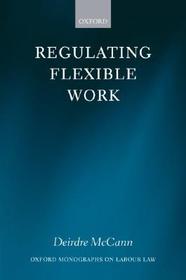
Regulating Flexible Work
Series: Oxford Labour Law;
- Publisher's listprice GBP 117.50
-
53 051 Ft (50 525 Ft + 5% VAT)
The price is estimated because at the time of ordering we do not know what conversion rates will apply to HUF / product currency when the book arrives. In case HUF is weaker, the price increases slightly, in case HUF is stronger, the price goes lower slightly.
- Discount 10% (cc. 5 305 Ft off)
- Discounted price 47 746 Ft (45 473 Ft + 5% VAT)
Subcribe now and take benefit of a favourable price.
Subscribe
53 051 Ft

Availability
printed on demand
Why don't you give exact delivery time?
Delivery time is estimated on our previous experiences. We give estimations only, because we order from outside Hungary, and the delivery time mainly depends on how quickly the publisher supplies the book. Faster or slower deliveries both happen, but we do our best to supply as quickly as possible.
Product details:
- Publisher OUP Oxford
- Date of Publication 6 March 2008
- ISBN 9780199218790
- Binding Hardback
- No. of pages224 pages
- Size 242x163x18 mm
- Weight 487 g
- Language English 0
Categories
Short description:
This book examines the regulation of 'flexible' or 'non-standard' forms of work, including part-time, temporary and temporary agency work. It explores how labour law can evolve to protect workers more adequately in the changing workforces and evolving working arrangements of contemporary industrialized economies.
MoreLong description:
The rhetoric of 'flexibility' and its potential to empower workers forms a key part of employment policy at the EU level. This book examines the regulation of 'flexible' or 'non-standard' forms of work, which include part-time, temporary, and temporary agency work. It unites analysis of changing patterns of work with exploration of the policy debate about how such work should be regulated. McCann explores how workers in non-standard jobs have traditionally been excluded from the protection of labour law or treated less favourably than the full-time permanent workforce because labour laws have been designed around the 'standard' full-time permanent employee.
Analysing in detail recent United Kingdom legislative reforms and the wider context of the EU and International Labour Organization, this book shows how, although flexible working arrangements are now more strongly protected, they are not fully integrated into UK labour law.
McCann ascribes the continuing disadvantage of flexible workers to the quest to maintain a 'flexible' labour market. She contends that the current balance between ensuring flexibility for employers, and ensuring minimum standards for workers is undermining protection for non-standard workers by allowing their employment rights to be derogated in the interest of labour market flexibility.
Table of Contents:
Table of cases
Table of statutes
Flexibility, Non-Standard Work, and Labour Market Disadvantage
'The Employee' and 'The Worker': Broadening The Scope of Labour Law
Part-Time Work: Flexibility and Fairness for Working Mothers?
Permanency and Protection: The Regulation of Temporary Work
Agency Workers: Capturing the Tripartite Relationship
Conclusions
Bibliography

